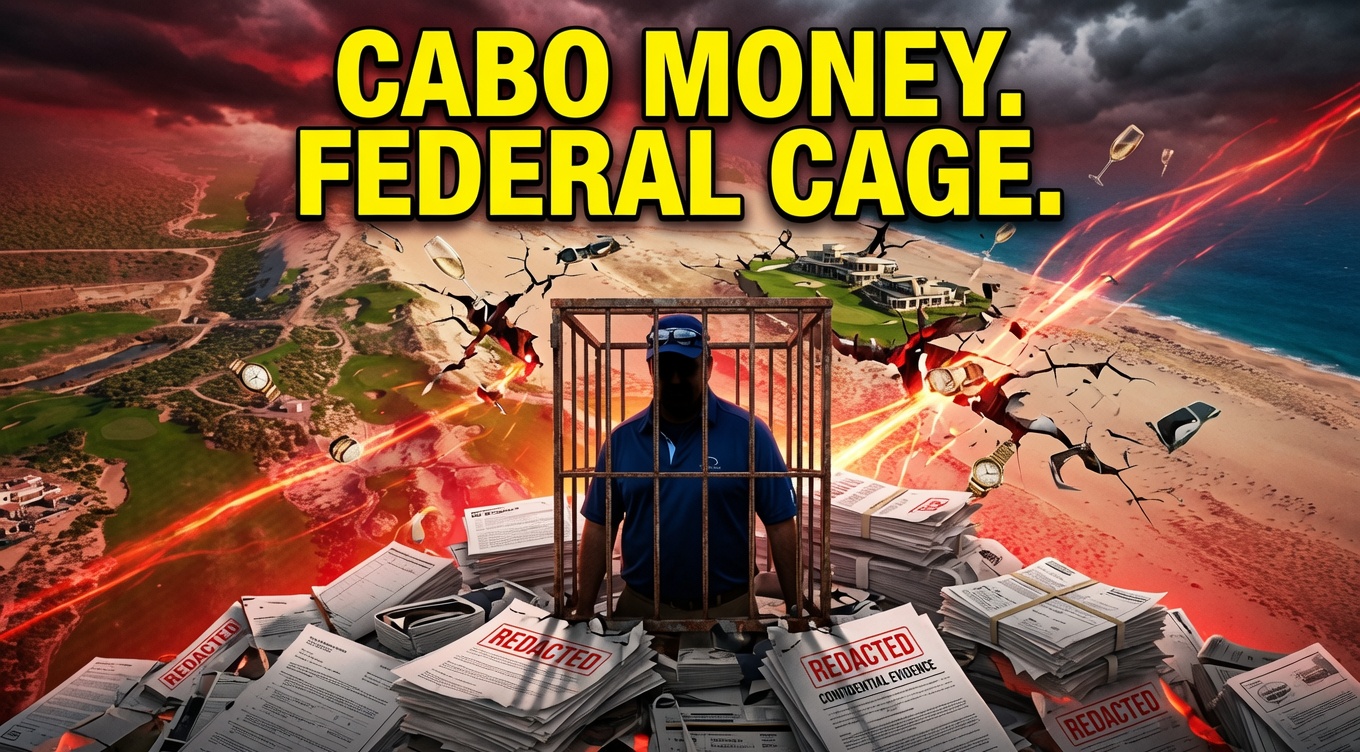
The Government secured a Lawfare conviction, but the Ken Jowdy transfers and investor-authority battle never disappeared.
LUTHMANN NOTE: The Kenner case is not compelling because a convicted man says the government wronged him. Federal prisons are filled with men making that claim. It is compelling because the documents refuse to behave. Lawsuits, judgments, bank records, witness statements, and federal exhibits keep dragging Kenneth Jowdy back into the center of the story. The government won its verdict. Kenner lost his appeal. But verdicts do not erase contradictions, and bureaucracy does not transform disputed evidence into settled truth. Now cancer is running the clock. The system says the story ended years ago. The file keeps saying otherwise. This piece is “Shadows of the Syndicate.”

By Richard Luthmann and Fernando Jiménez Burke
The First Collision
(CENTRAL ISLIP, NEW YORK) – Every good scandal begins with two stories that cannot both be true. In one version, Kenneth A. Jowdy is the polished visionary behind Diamante Cabo San Lucas, the founder-CEO who turned raw Baja coastline into a luxury golf empire, beginning with the 2009 opening of the Dunes Course and later expanding into a Tiger Woods-designed showcase.

In the other version, preserved in litigation long before the Philip Kenner trial became federal history, Jowdy is a magnet for investor fury: a developer sued in 2009 in Los Angeles Superior Court by a roster of former and current NHL players, including Tyson Nash, Bryan Berard, Jere Lehtinen, Sergei Gonchar, Michael Peca, and others, for breach of fiduciary duty, fraud, constructive trust, unjust enrichment, and accounting.
That second story alleged Jowdy solicited professional athletes and failed to carry out the most basic elements of the promised business plan.
The split-screen is where this chapter should live. Philip Kenner is not compelling because he says he was cheated. Half the federal docket is crowded with men saying somebody cheated them.
He is compelling because his story collides with public documents showing Jowdy was not some phantom later invented to dodge blame, but a real, litigated, money-soaked figure standing at the center of the Cabo project from the beginning.
That contradiction comes in hot: not as polite background, but as the first crack of thunder. On one side, the brochure. On the other, the summons.
And in the middle, a pile of vanished money big enough to turn partners into witnesses, witnesses into enemies, and a development dream into something far darker.
Shadows of the Syndicate: Where the Money Turned
The strongest version of this story does not ask anyone to accept a conspiracy before the receipts arrive. It walks the money.
One of the most useful public markers is a Nevada judgment involving Glenn Murray and Jowdy. In findings entered after trial, a Clark County court concluded that Jowdy had asked Kenner and another intermediary to help obtain roughly $800,000 in short-term financing, that Glenn Murray’s money was wired to escrow in August 2005, and that a contract existed under which Jowdy was to repay the principal plus a 10 percent return within 30 to 45 days.
The court found Jowdy failed to do so.
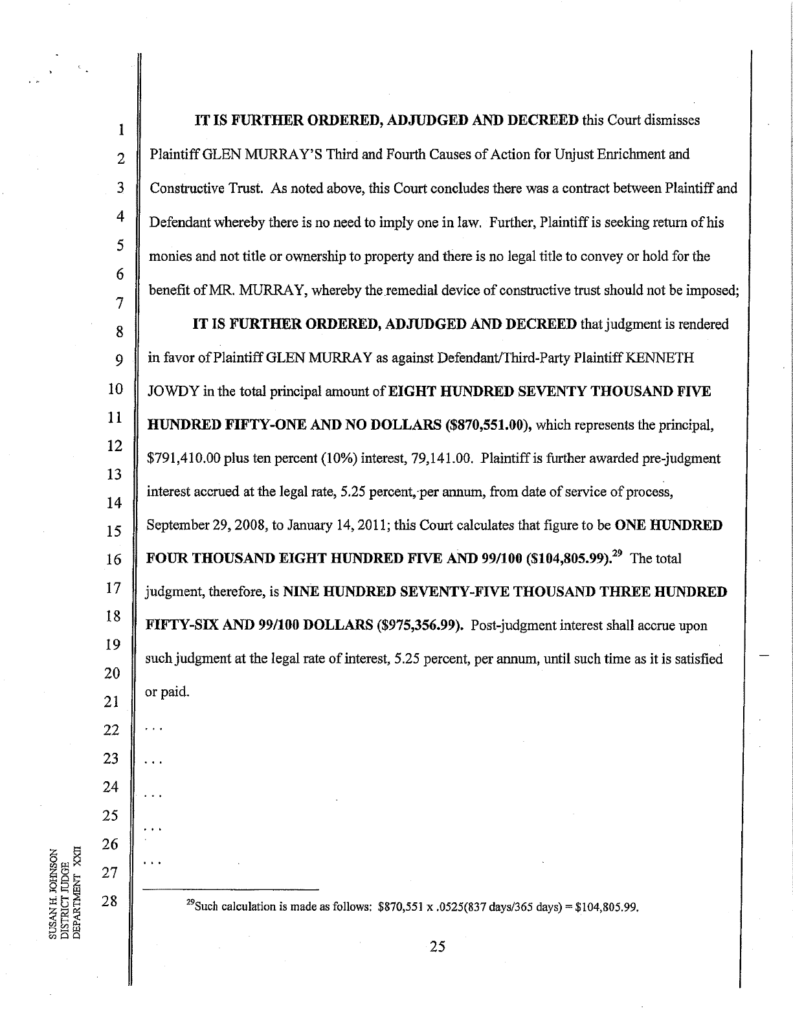
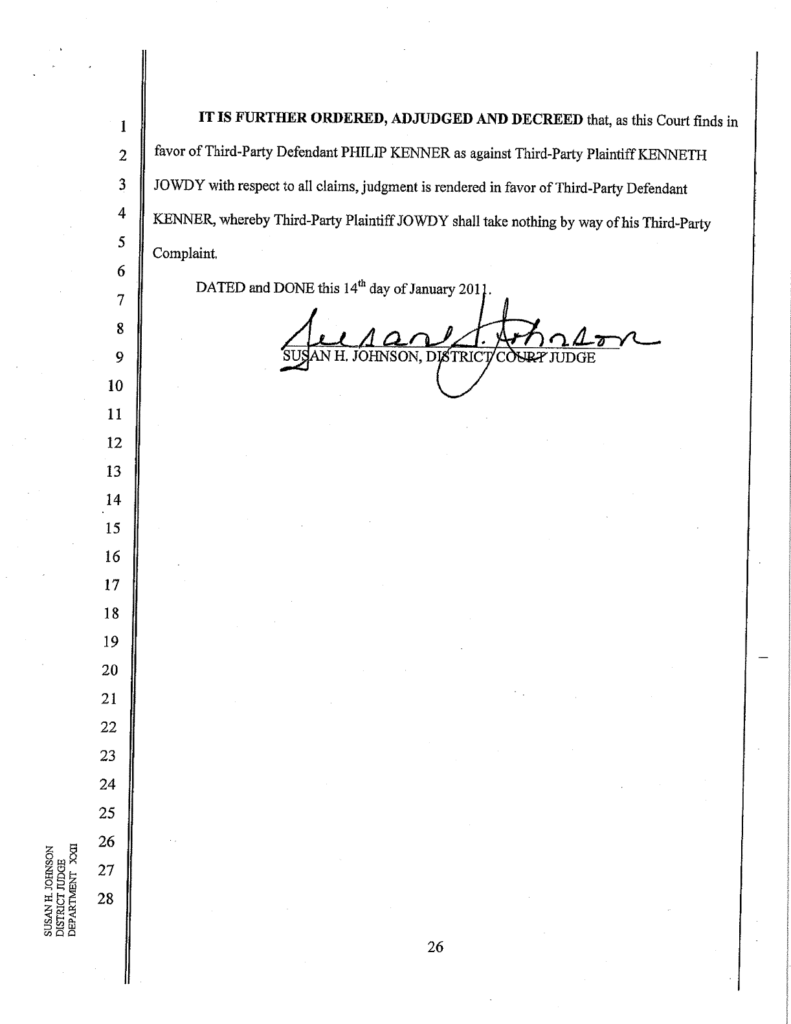
That matters because it places Kenner and Jowdy together not in rumor, but in documented financing relationships tied to real money, real dates, and real judicial findings.
The later federal record makes the same terrain impossible to ignore. In denying Kenner’s post-trial motions in 2017, Judge Joseph Bianco repeatedly addressed Kenner’s argument that Hawaii-project money sent to Jowdy was reflected as “loans” to the Jowdy Diamante development; the court rejected Kenner’s legal theory, but only after acknowledging that the Jowdy loan issue sat inside the evidentiary spine of the case.
That is the reality: Kenner cannot oversell what the courts proved, and he cannot underplay what they unmistakably show. Jowdy was not scenery. He was a major financial node.
Kenner’s public theory casts him as the straw man in a larger protected machine. The government’s theory casts him as a recipient of unauthorized diversions.
Either way, the money does not drift to Cabo by accident. Somebody moved it, somebody signed for it, and somebody built a kingdom while the paper trail kept bleeding.
Shadows of the Syndicate: The Government Won the Verdict but Not the Entire Argument
The federal government’s version is not ambiguous. After a nine-week trial, the Eastern District of New York convicted Phillip A. Kenner in July 2015 of conspiracy to commit wire fraud, multiple wire-fraud counts, and conspiracy to commit money laundering.
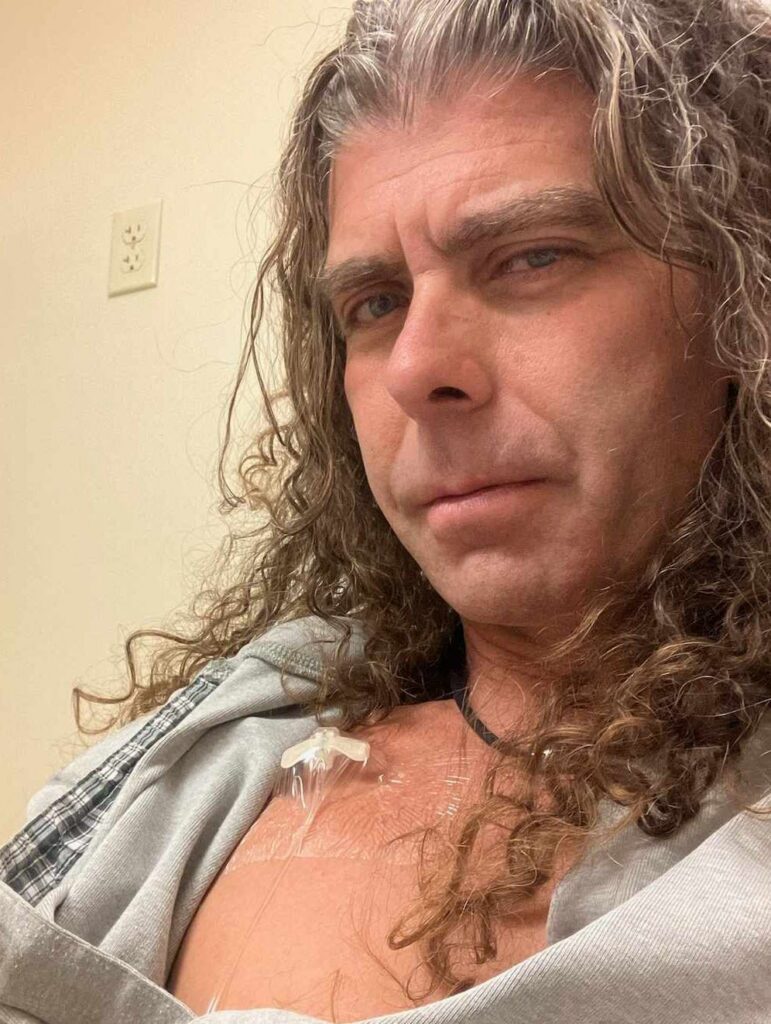
In 2020, the U.S. Attorney’s Office announced that Kenner had been sentenced to 17 years in prison, with the court imposing a forfeiture money judgment of about $17 million and ordering forfeiture of, among other assets, his interest in an oceanfront resort in Mexico, real property in Hawaii, and a Falcon 10 jet.
In July 2023, the Second Circuit affirmed. The appellate court even said the district court’s interested-witness jury charge was erroneous under later Second Circuit precedent, but held the error harmless in light of what it described as overwhelming testimonial and documentary evidence.
On the perjury issue, the court also addressed Kenner’s claim that witness John Kaiser falsely denied advance knowledge of Jowdy-related transactions; the panel held that the handwritten interview notes, standing alone, were not “incontrovertible evidence” that Kaiser had testified falsely. The Supreme Court later denied certiorari.
All of that is the law of the case, and no one duck it for one second. But neither should it pretend the official win erased every unresolved pressure point.
The same public decisions keep returning to the Jowdy transactions, the investor-authority dispute, and the ferocious fight over whether those transfers were theft, loans, or a rearranged narrative after the collapse.
That is why the file still breathes. Public docketing shows 1100+ entries. This was never a neat courtroom morality play.
It was a trench war with verdict sheets, forfeiture orders, appellate affirmance, and a residue of unanswered questions that Kenner has refused to bury.
Shadows of the Syndicate: The File Reopened as a Cancer Clock
The most haunting turn in the Kenner saga is that the old fraud war has now fused with a prison-medical story. Kenner’s current fight is not a pardon campaign, but rather a survival battle, arguing that his compassionate-release filings describe years of delayed cancer diagnosis, interrupted treatment, and a Bureau of Prisons bureaucracy that controls the calendar of whether he lives long enough to keep litigating.
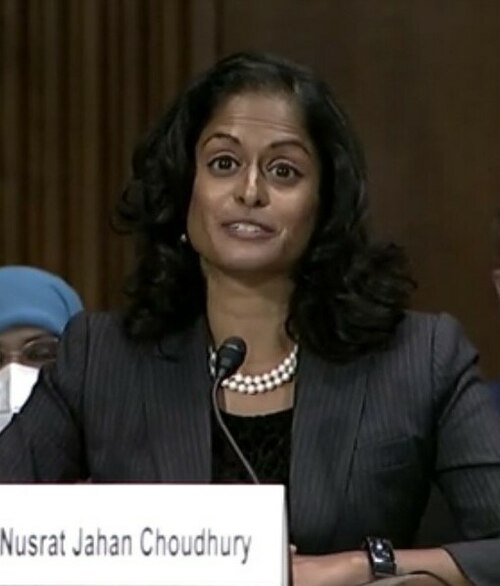
Kenner’s allegations land harder because an official Department of Justice watchdog report in May 2025 found broad colorectal-cancer screening and follow-up failures inside the BOP: among the inmates sampled, the Office of the Inspector General found an average wait of eight months between a positive colorectal screening and a colonoscopy, and also found gaps in follow-up care and wide variation across facilities.
That official report does not prove Kenner’s specific account on its own. But it does give a verified institutional backdrop for why his medical allegations cannot be waved away as theatrical self-pity.
The Kenner story has shifted from financial noir to mortality timer. Because once the story becomes a cancer clock, every delayed scan feels like more than negligence. It feels like process as punishment.
The old question was who stole the money. The new question is who benefits if the man still accusing the powerful runs out of time before the record is fully aired.
That is not a courtroom finding. Not yet. It is, however, the dark pulse driving the latest round of federal court filings.
The File That Refuses Burial
The Kenner story begins where the best federal thrillers all begin: with a body of evidence, a body in custody, and a body politic that has lost faith in tidy explanations.
The most explosive version of the story places former FBI Director Louis Freeh, former FBI agent Matthew Galioto, John Kaiser, and Jowdy inside a long-running architecture of protection, retaliation, and narrative control.
Public appellate rulings do not explicitly endorse the broader cabal theory. But those rulings also do not erase the documented financial relationships with Jowdy, the athlete litigation, the Nevada judgment against Jowdy, the repeated post-trial fights over the Jowdy transfers, or the sheer size of the post-conviction paper war.
That is the first breach charge against an old institutional wall, bolstered by lawfare and weaponized justice. Kenner, in this rendering, becomes the man who would not die on schedule, would not shut up on command, and would not let the file be buried beneath verdict forms and bureaucratic dust.
Ken Jowdy becomes the gleaming resort-builder whose name keeps surfacing wherever the money trail bends toward Cabo.
And the system itself becomes the third character: sometimes prosecutor, sometimes jailer, sometimes witness, always insisting the story is already over while the docket says otherwise.
The reckoning has not yet arrived, but the lock on the evidence room is rusting through.
The fog has not cleared. It has started to tear. And once that happens, the men who lived safely inside the blur begin to look less like titans and more like targets.
About The Author
