

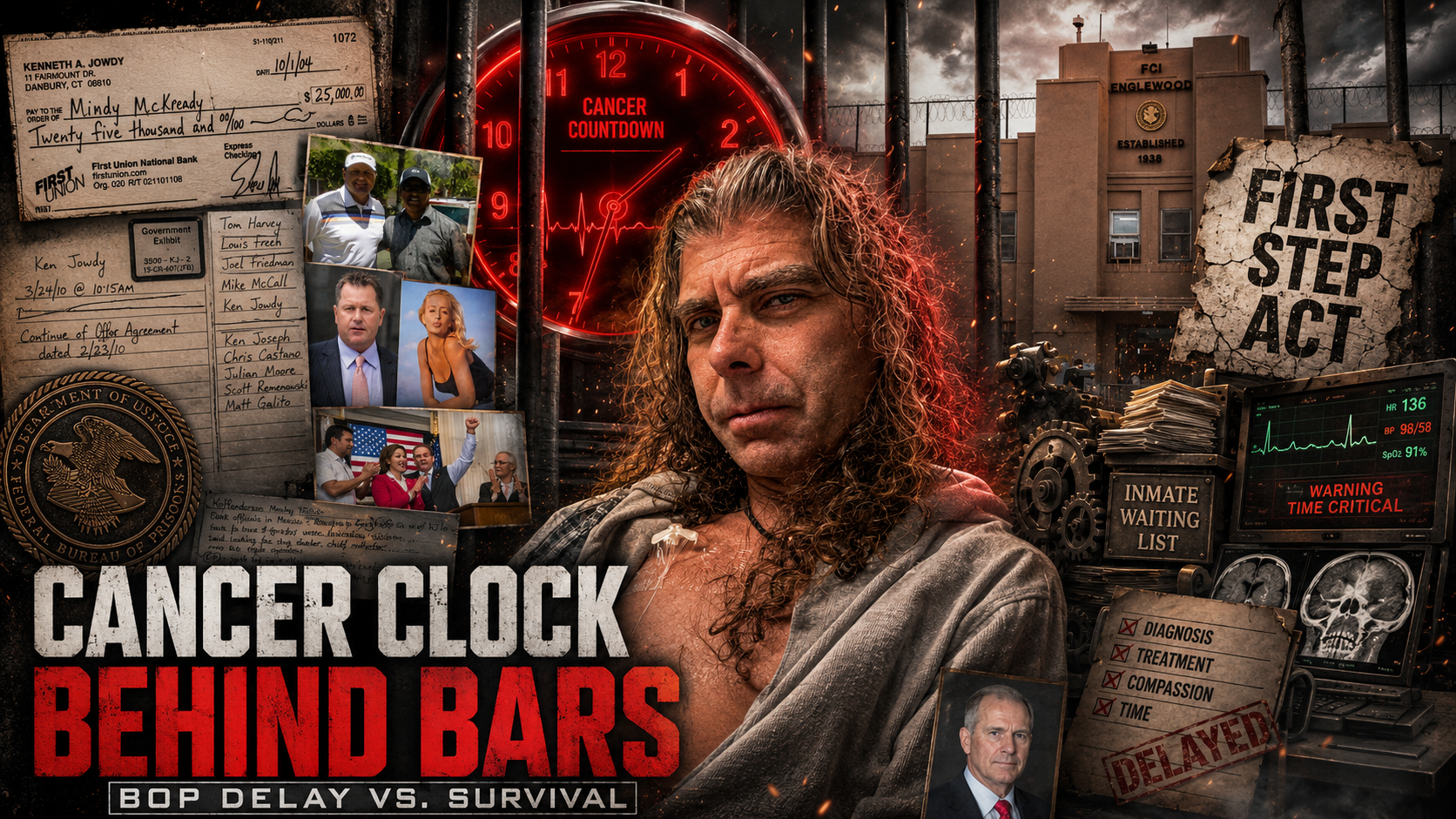
For Philip Kenner, federal custody has become a cancer clock of treatment delays and a countdown for survival.
LUTHMANN NOTE: This is not a pardon story. Not yet. This is a survival story, and America should be mature enough to separate the two. Philip Kenner can have enemies, accusers, prosecutors, and critics, and still have a right to timely cancer care. That should not be controversial. The First Step Act was not passed so bureaucrats could keep playing old prison games under new statutory language. When a prisoner’s medical calendar becomes a countdown clock, courts should not wait for the obituary before calling the machinery what it is. Sunlight belongs here, before another savable life disappears inside federal process. This piece is “The Man in the Cage.”



By Frankie Pressman, Richard Luthmann, and Fernando Jiménez Burke
In December 2018, President Trump signed the most progressive prison reform litigation in half a century: The First Step Act. It was a breakthrough that prisoners and their families had prayed for for decades. Finally, relief. But sadly, those in the throes of victory quickly saw bureaucratic incompetence at its finest. It was impossible to retrain bureaucratic monkeys to now follow congressional statutes and implement them effectively.
Thus, nearly a decade has passed, and the lawsuits against the Bureau of Prisons have intensified, drowning the federal court system in avoidable litigation, as the Bureau of Prisons continues to implement its own corrupt brand of justice by simply failing to follow President Trump’s groundbreaking First Step Act.
In this current, horrific tale, despite what Philip Kenner has medically, endured, and miraculously sustained life during his fight to see the end of this legislative quagmire, the BOP’s failure to implement unambiguous law may cost him his oversize, This is the type of bureaucratic oversight, which is destroying America from within; regardless of the petitioner and how they got to the federal courts seeking relief.

This is not a pardon story. It is a survival story.

Long before the names Diamante, Freeh, Clemens, Jowdy, McNamee, McCready, ex-NYPD cops, or the questions surrounding NHL money trails enter the picture, there is a more immediate issue sitting inside a proverbial federal prison cell: a man with cancer who believes time is no longer measured in months or years, but in missed appointments, delayed diagnostics, and interrupted treatment.
None of this complies with Federal law or even basic humanity.
Philip Kenner’s clock began ticking long ago with a cancer diagnosis that transformed every medical decision into a race against progression. For any cancer patient, treatment is measured by precision and timing. Delays can carry consequences that cannot be undone.
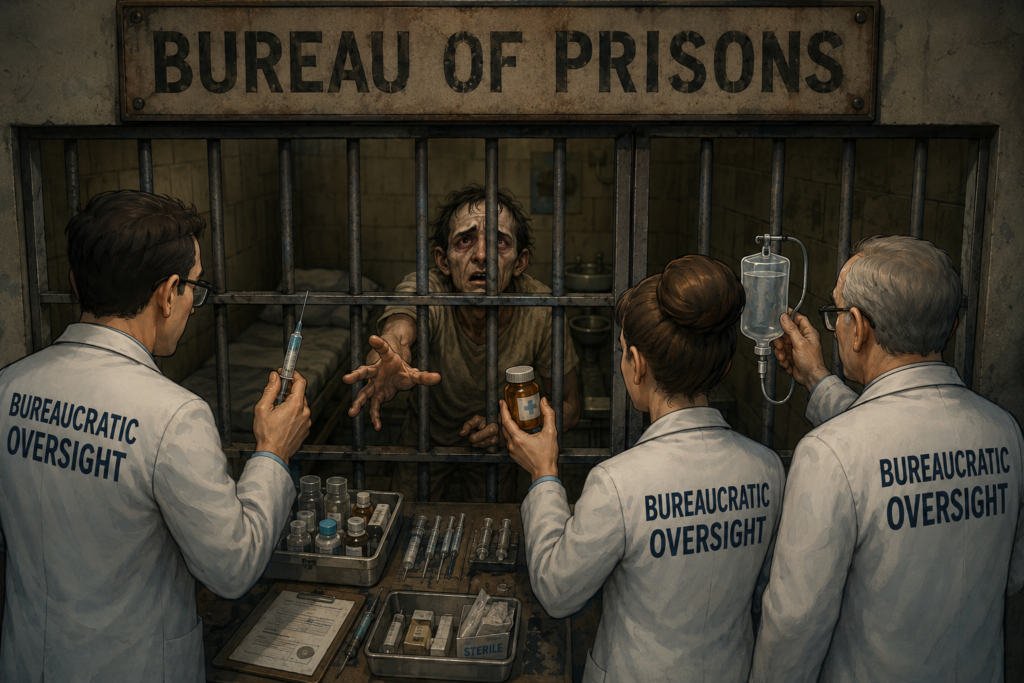
In May 2025, the United States Office of Inspector General, overseeing the Bureau of Prisons, identified gross medical indifference and deliberate delays in scheduling appropriate cancer protocols. Despite the egregious findings of preventable cancer deaths, Kenner witnessed zero paradigm shift in the BOP following the DOJ Inspector General’s report on colorectal screening.
For a period, Kenner was released under provisions associated with the CARES Act, a pandemic-era program that allowed certain federal inmates to serve portions of their sentences outside prison walls. During that time, he has identified in federal filings greater access to medical specialists, continuity of care, and access to a full panoply of holistic and Ayurvedic medicines.

Then came the return to custody; without the BOP following its own remand protocols, allowing Kenner access to the BOP’s administrative remedy appellate process.
According to Kenner, that return marked the beginning of a medical maze. He alleges that diagnostic evaluations were delayed without priority, specialist access became more difficult, and treatment schedules that should have moved with urgency became tangled in bureaucracy. Every postponed test, every rescheduled consultation, and every interruption in treatment became, in his view, another turn of the cancer clock—effectively reducing Kenner’s quality of life and remedy options for treatment.
Federal officials would likely present a different picture. Their position would be that the Bureau of Prisons is providing constitutionally adequate medical care and that inmates receive treatment consistent with established procedures and available resources. Under the BOP’s flawed premise, if somebody had a broken finger, cutting one’s arm off at the shoulder would resolve the finger problem. From their skewed perspective, they would not be wrong—courts have too often agreed with this surreal perspective.
Between those competing narratives sits the central question.
What happens when a patient’s survival depends on speed, but every medical decision must pass through the machinery of incarceration? Nothing, except “kick the can down the road” and systematic avoidance has occurred over the last 6 to 7 years in Kenner’s medical battle to stay alive.
For Kenner, the answer is deeply personal. He argues that imprisonment has become more than confinement. He believes it has become control over access to the very care that may determine whether he lives long enough to tell the rest of his story.

The government sees custody as a lawful sentence being carried out with appropriate medical oversight.
Kenner sees something else. He sees a countdown.
The dispute is no longer simply about prison conditions or criminal justice policy. It is about whether a cancer patient can realistically pursue life-saving treatment while confined within a system designed primarily for security rather than medicine.
That question hangs over every chapter that follows.
Before the investigations, before the allegations, before the money trails and institutional names, there is a man sitting in a proverbial dungeon, watching the medical calendar move forward lacking urgency, and resolve.
And according to his most recent Eastern District of New York filings, complementing the Southern District of Florida and District of Colorado cases. Kenner’s multiple court filings identify that cancer is moving faster than the bureaucracy – – stymying 21st-century options and congressionally granted liberty rights.

Will any of the current presiding justices finally break the pattern of bureaucratic interference, incompetence and quagmires—and allow a man to seek medical solace during his reduced, quality-of-life, final days?
Related posts:
Frankenseat Showdown Splits Staten Island
Putin's Pal in Albany? New York’s Judicial Ethics Watchdog Linked to Russian Oligarch-Connected Fund
Kathy Hochul Gulag Exposed: The Ryan Flynn Interview
Kamillah Hanks Dominoes Fall: Adams Quits, Staten Island Dems Machine Shifts Mamdani
Kathy Hochul’s Secret Affair
McMahon’s Fear Fraud Scandal: Felony Free Speech or Perjury by a Politician?
About The Author
