Feds Investigating NYC Council Hubby for Using City Hall as Leverage, Explosive Court Filing Claims
LUTHMANN NOTE: This filing hits a nerve because it exposes how power actually works in New York. When insiders get sued, the system slows down. Judges rotate. Motions pile up. Discovery never starts. Now you have silence from every key player except one defendant judge. That is not normal. Add allegations of developer shakedowns and federal investigation, and the silence gets louder. The Manhattan Dems’ political machine and the DSA factions both have reasons to keep this buried. But lawsuits do not disappear. At some point, someone testifies under oath. That is the moment everyone here is trying to avoid—except me. This piece is “Hanks Developer Shakedown Bombshell.”

By Frankie Pressman and M. Thomas Nast with Richard Luthmann
The Filing That Calls the Bluff
Richard Luthmann came back swinging with a new Reply Affidavit in Luthmann v. Hanks, the long-running Manhattan fee case that he says stopped being a collections matter years ago. The filing, entered as NYSCEF Doc. 133 on April 13, says the core issue is no longer just unpaid legal bills. It is whether a politically wired case can ever reach discovery in New York County when the judges, the defendants, and the party machinery all sit inside the same orbit.
Luthmann says his motion to recuse Justice Emily Morales-Minerva is returnable April 15 and seeks immediate disqualification, vacatur of any orders entered during her “conflicted tenure,” and reassignment to a judge free of similar ties.

The new filing hammers one fact over and over: he was served with no opposition from Kamillah Hanks, no opposition from Kevin Barry Love, no opposition from the Hanks campaign committee, and no substantive response from City Law Department lawyers who appeared on the docket.
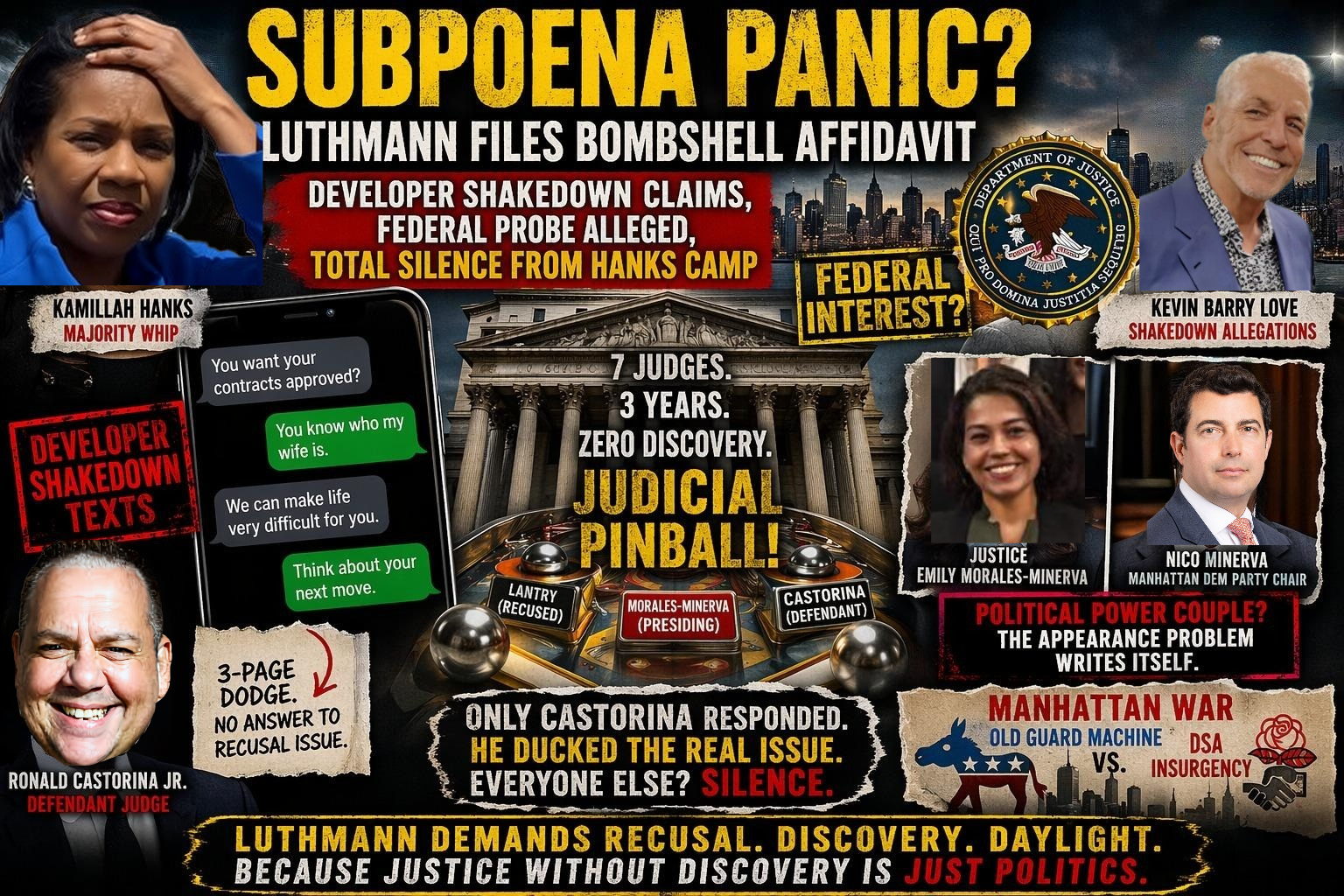
The only opposition came from Richmond County Justice Ronald Castorina Jr., himself a named defendant, which Luthmann calls a “self-serving smoke screen” designed to keep the case trapped above discovery, where nobody has to sit for depositions or make sworn admissions.
Castorina’s March 13 opposition was only three pages long. It leaned on People v. Moreno and argued that Morales-Minerva’s recusal is discretionary because no statutory disqualification exists.
It did not answer the political optics that drive the motion.
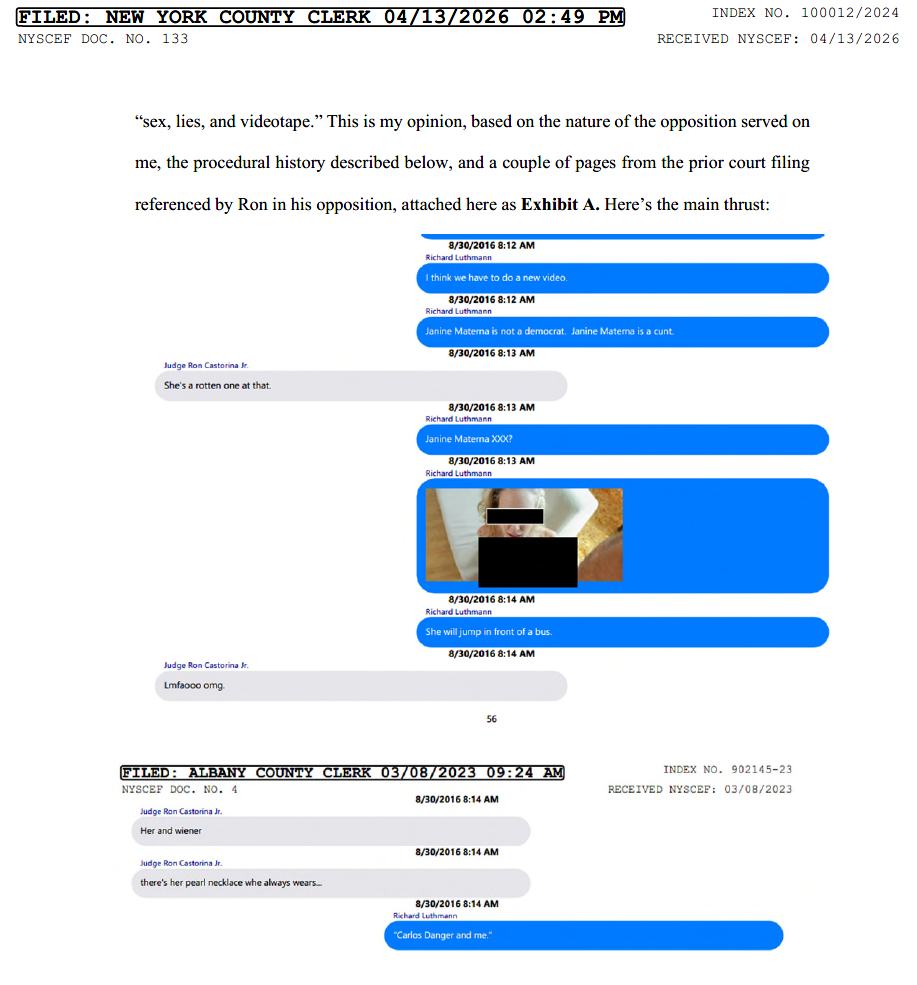
Luthmann says that is the pressure point.
Castorina did not and could not erase the public record. Justice Brendan Lantry already recused himself in this same case under Judiciary Law § 9 after acknowledging that his impartiality “may be questioned” because of his ties to parties and campaign activity related to Castorina. Justice Lantry did what Morales-Minerva has not: he put the conflict on paper and stepped aside.

In Luthmann’s telling, that contrast tells the whole story. One judge saw the danger and exited. Another has stayed put while the case keeps bouncing.
Hanks Developer Shakedown Bombshell: The Manhattan Machine Problem
Luthmann’s filing pins the recusal argument on one explosive fact: Justice Emily Morales-Minerva is married to Domenico “Nico” Minerva, a figure publicly identified as Manhattan Democratic Party chair and a close ally of Keith Wright, the longtime county power broker. The filing says Minerva is also a partner at Labaton Keller Sucharow LLP, which gives him both political and private-sector clout.
Luthmann argues that this is not some random household coincidence. He says it places the presiding justice inside the same political ecosystem that shapes judicial screening, endorsements, party patronage, and the fortunes of Democratic insiders.
The New York courts’ own rules require disqualification when a judge’s impartiality “might reasonably be questioned.” Luthmann quotes that standard directly. He pairs it with the broader rule that judges must avoid both impropriety and the appearance of impropriety.
He then brings the politics home. Kamillah Hanks is not a minor local officeholder. Council records show she was designated Majority Whip effective January 15, 2026, a formal leadership post in Speaker Julie Menin’s new Council. Luthmann says that makes Hanks an “inner-circle” player, not an outsider. He has already framed Menin’s decision to elevate Hanks as a judgment call that could blow back on the Manhattan establishment.

Luthmann described the case as “judicial pinball,” noting that Luthmann’s $86,000 fee suit ricocheted across seven judges with years of delay and no discovery. That article said the case looks less like a billing dispute than a political pressure chamber.
The filing also widens the frame beyond Hanks. Luthmann says Manhattan Democrats are split in an open war between the old Keith Wright machine and the insurgent Democratic Socialists. He alleges the current mayoral administration under Zohran Mamdani has incentives to keep City attorneys out of a politically radioactive case that touches judicial screening, patronage, and machine politics.
While Luthmann acknowledges public claims that Corporation Counsel acts independently, he says real politics still shapes real litigation in New York City.
The point is blunt. If neither faction wants discovery, silence becomes a strategy. That is why, Luthmann says, the Law Department stood down.
Hanks Developer Shakedown Bombshell: The Allegations and the Silence
Then comes the part that turns a recusal motion into a political grenade. In paragraphs 30 through 33, Luthmann says the lack of opposition from Hanks, Love, and their campaign is not just litigation tactics. He says, upon information and belief, they are “navigating exposure elsewhere.”
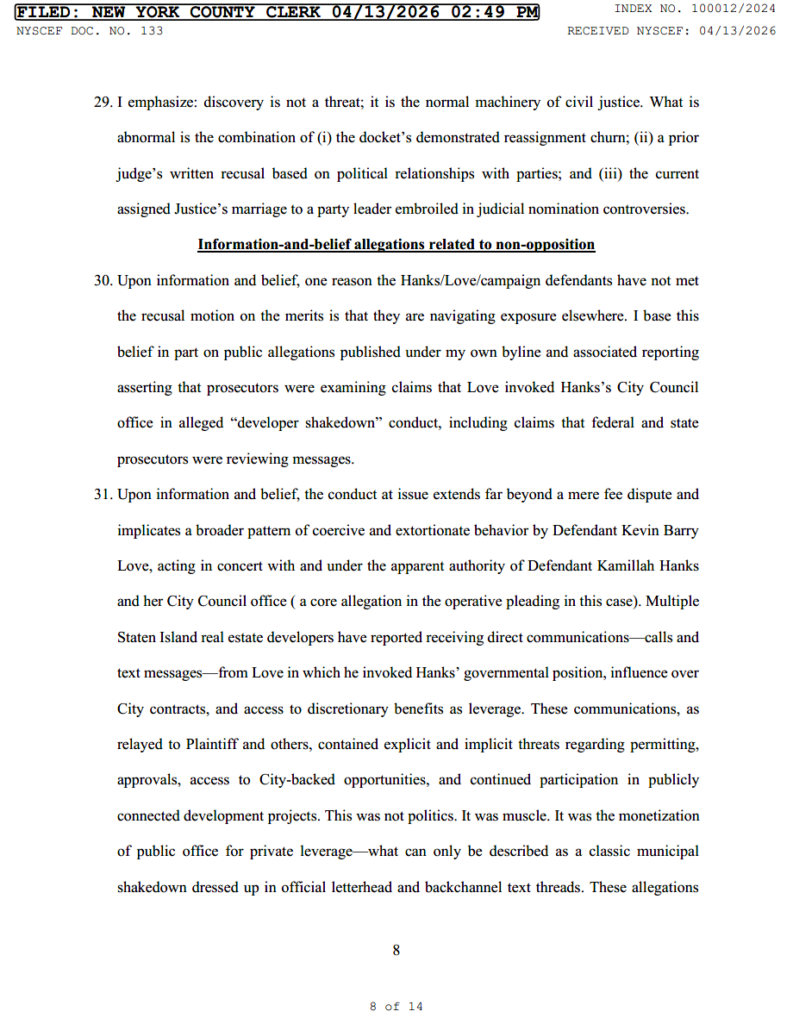
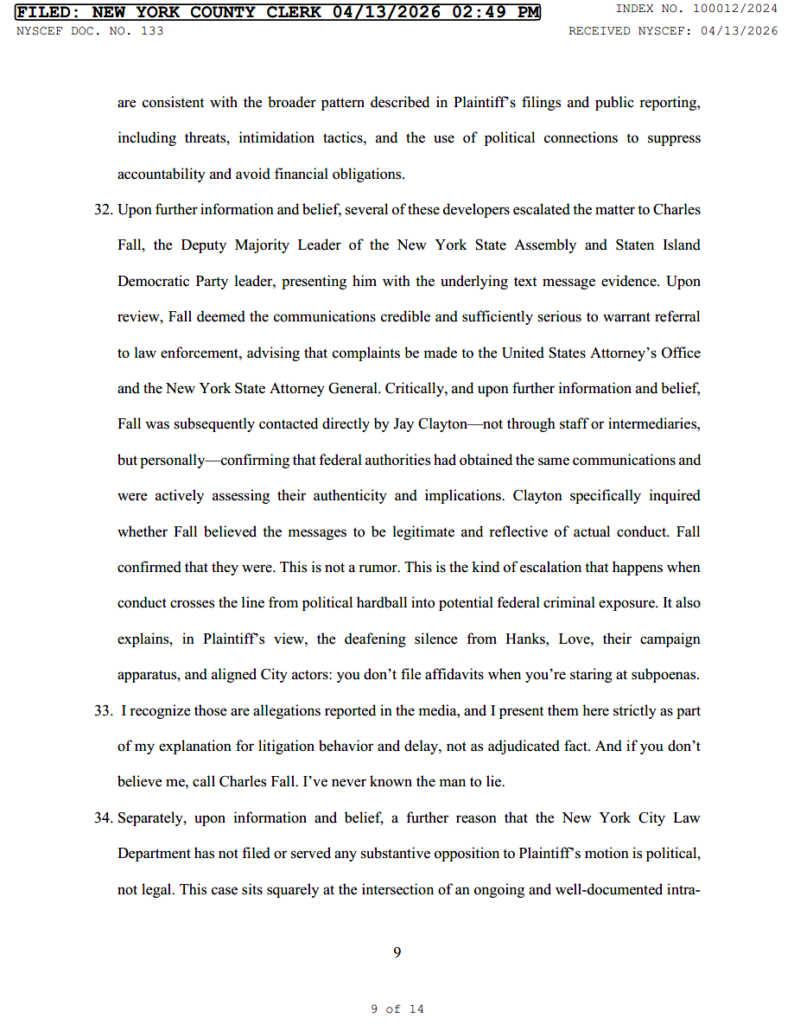
He ties that silence to public allegations that Kevin Barry Love used Kamillah Hanks’s City Council office as leverage in a developer shakedown scheme. The filing says multiple Staten Island developers reported calls and texts from Love invoking Hanks’s government position, influence over city contracts, access to benefits, and power over approvals.
Luthmann calls it “the monetization of public office for private leverage” and “a classic municipal shakedown dressed up in official letterhead and backchannel text threads.”
That is not a passing line in the filing. It is the beating heart of his explanation for why the Hanks side has chosen silence.
![Charles Fall [R] with community activist Jozette Carter-Williams [L], former wife of slain NYPD Officer Gerard Carter.](https://nynewspress.com/wp-content/uploads/2026/03/1723565441196.jpeg)
Luthmann goes further. He says several developers brought the messages to Assemblyman Charles Fall, the Staten Island Democrat and Deputy Majority Leader in Albany. According to the Reply Affidavit, Fall reviewed the texts, found them credible, and told the developers to contact federal and state prosecutors.
The filing then makes its most provocative factual claim.
Luthmann says, again on information and belief, that U.S. Attorney Jay Clayton personally called Fall after getting the same messages and asked whether Fall believed they were authentic. Fall allegedly said yes.
Luthmann’s line is pure tabloid thunder: “You don’t file affidavits when you’re staring at subpoenas.”
None of this has been adjudicated. Luthmann says so himself. He presents the allegations as an explanation for the defendants’ behavior, not as proven facts. But in a case already clogged by delay, the allegation lands like a brick through a window.
The broader record shows why Luthmann thinks discovery is the battlefield. His original recusal papers said this case involves political operators, party insiders, judges, and campaign veterans stretching back to 2017. Hanks already admitted in court filings that she used Luthmann’s legal work for campaign warfare, including knocking a rival off the ballot, then never paid the full bill. It also said Love’s answer to collection pressure was menace, not settlement.
That is why Luthmann keeps using one phrase.
He wants “sex, lies, and videotape.”
He wants depositions and sworn testimony. And he says Castorina, Hanks, Love, and the machine all know exactly why.
Hanks Developer Shakedown Bombshell: Why This Filing Matters Now
Luthmann’s latest filing is not a polite lawyer’s note—he’s neither a lawyer nor polite.
It is a public dare, saying the court system now faces a choice. Either it treats the recusal issue seriously and moves the case to a judge outside the political blast zone, or it confirms every suspicion that the courthouse is being used to shield insiders from daylight.
Luthmann cites 22 NYCRR 100.3(E)(1), 22 NYCRR 100.2, Judiciary Law §§ 9 and 14, and New York appellate cases that say appearance matters because public trust matters. Discovery is “the normal machinery of civil justice.” What is abnormal, he says, is seven judges, years of drift, a prior recusal, and a current judge whose spouse sits inside the same party machinery that benefits from delay.
For Luthmann, the filing is also a political document, telling readers that the silence is the story. Hanks did not answer. Love did not answer. The campaign did not answer. The City did not answer.

Castorina answered, but only to argue that judges are usually the “sole arbiter” of recusal.
Luthmann’s response is simple—“sole arbiter” does not mean above scrutiny. It does not erase optics or make the Manhattan machine disappear. And it does not stop discovery forever. If the motion is denied, the political stench gets worse. If it is granted, the case finally may move toward the one thing Luthmann says the system fears most: sworn testimony under oath.
That is why this filing matters. Luthmann is not just asking for another judge. He is accusing the New York political class of running out the clock. He says the courthouse has become a bunker for party insiders, deadbeats, and frightened defendants who know discovery will hurt.
His latest affidavit turns that accusation into a record document. On April 15, the court will begin to decide whether it wants to look like a tribunal or a clubhouse.
Related posts:





About The Author