

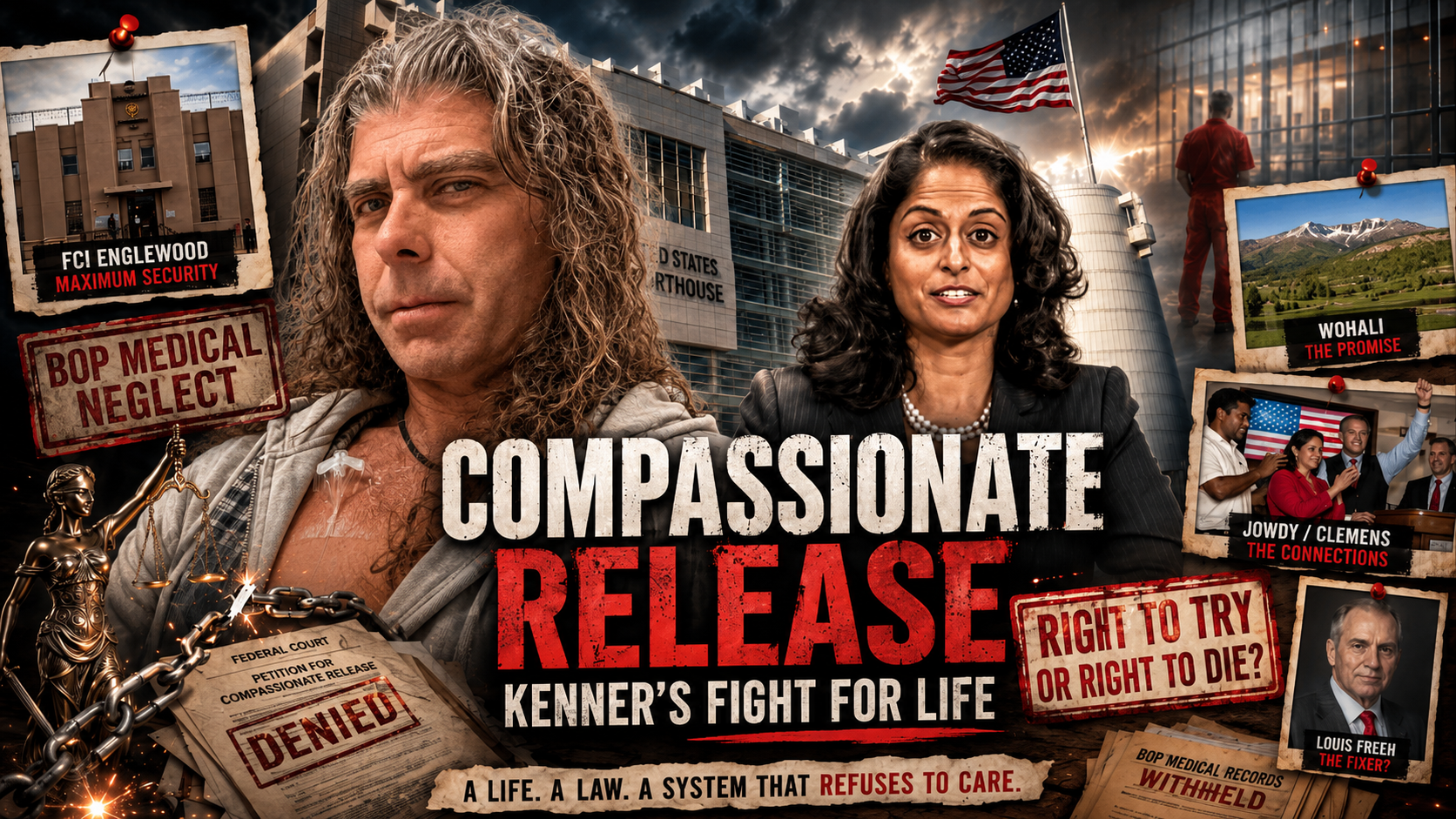
Philip Kenner’s Fight Turns Compassionate Release Into EDNY Showdown
LUTHMANN NOTE: Philip Kenner’s case is not just another compassionate-release motion. It is a federal prison Pandora’s Box. The Supreme Court narrowed one path in Rutherford, but it did not give the Bureau of Prisons permission to turn cancer care into bureaucratic captivity. Kenner says he faced years of cancer-related delay, interrupted treatment, and blocked outside medical options while the government hides behind the line that he is still alive, so the care must be adequate. That is not justice. That is paperwork posing as mercy. If courts cannot intervene here, compassionate release becomes deathbed theater. This piece is “Cancer Behind Bars.”



By Rick LaRivière, Richard Luthmann, and Fernando Jiménez Burke
(CENTRAL ISLIP, NEW YORK) – The Supreme Court just narrowed compassionate release, and the Bureau of Prisons now has another reason to smile behind the razor wire. In Rutherford v. United States, the Court held that a nonretroactive change in sentencing law cannot itself qualify as an “extraordinary and compelling” reason to reduce a federal prisoner’s sentence.
In courthouse language, that sounds clean, technical, almost bloodless. In federal prison reality, where medical delays become tumors, bureaucratic indifference becomes organ loss, and dying men are told to keep waiting for the next sick call, it is another tightening of the noose.

Compassionate release was supposed to be the safety valve in a federal sentencing system that abolished parole and replaced human judgment with mathematical punishment. It was supposed to recognize that time changes everything. Bodies fail. Diseases spread. Families collapse. Medical science moves. Prison conditions become lethal.
The government’s authority to punish does not include a hidden license to medically destroy the prisoner while pretending that the sentence is merely being “administered.”
That is why the Phillip A. Kenner case matters. Kenner is not just another federal inmate filing another desperate motion from behind the wall. His case now sits at the intersection of cancer, alleged Bureau of Prisons medical indifference, Right-to-Try medical autonomy, contested prosecutorial history, and the post-Rutherford question every federal judge must face: if sentencing disparity is no longer enough to open the compassionate-release door, what happens when the prisoner is not merely serving time, but fighting for his life against the machinery that controls his doctors, records, treatment access, transfers, medications, and medical destiny?
Kenner’s case frames the issue bluntly: Can Pandora’s Box save Kenner’s life?
That may sound dramatic until one considers the allegation at the heart of the filing narrative — a documented four-and-one-half-year delay in diagnosing cancer while Kenner was in Bureau of Prisons custody. If true, that is not ordinary prison discomfort.
That is not the inconvenience of incarceration. That is the state taking possession of a human body, missing or delaying the warning signs, and then claiming institutional competence after the disease has already had years to advance.
Cancer Behind Bars: Rutherford Closed One Door. Medical Neglect Must Open Another.
The Rutherford decision restores finality as the Supreme Court’s governing instinct in compassionate-release cases involving nonretroactive sentencing changes. The Court said Congress made a policy choice when it changed certain sentencing laws but did not make those changes retroactive, and judges cannot use compassionate release to override that legislative choice.
That holding will crush a class of prisoners serving old sentences that would be shorter under modern law, even where the disparity is severe.
But Rutherford does not eliminate compassionate release. It redirects the fight back to the traditional heartland: serious illness, terminal disease, advanced age, family catastrophe, disability, and extraordinary personal circumstances.

That means defendants can no longer stroll into court with a broad fairness argument and expect the First Step Act to do the heavy lifting. They must bring medical records, treatment histories, expert declarations, timelines, contradictions, and proof that continued confinement is no longer punishment, but avoidable human destruction.
Kenner’s case belongs in that sharper battlefield. According to the record, Kenner repeatedly presented escalating symptoms and medical concerns at multiple BOP facilities before meaningful diagnostics were performed. The allegation is not merely that the BOP failed to offer boutique medicine or concierge care. The allegation is that after a near bleed-out emergency requiring outside emergency-room intervention in 2022, the BOP delayed cancer-related specialty diagnostics and follow-up evaluation for another six months.
By the time the system moved, the disease had allegedly progressed substantially.
That is the kind of fact pattern compassionate release was built to confront. Not because every prisoner with a medical complaint gets to walk free. And not because the conviction disappears or the victims stop mattering. But because the sentencing judge did not impose a secret second sentence of untreated cancer, medical captivity, and bureaucratic control over survival options.
A prison term is a deprivation of liberty. It is not supposed to become a forced medical experiment in delay, denial, and institutional self-protection.
Cancer Behind Bars: Kenner’s Case Is About Cancer, Control, and Custody
Kenner’s federal case is serious. He was convicted in the Eastern District of New York after a major fraud prosecution and ultimately sentenced to 204 months in prison, followed by three years of supervised release. He was later released to home confinement under the CARES Act before being remanded back into BOP custody after a Colorado protection-order arrest issue.
Those facts matter because any compassionate-release motion must confront the §3553(a) sentencing factors, including the seriousness of the offense, deterrence, public protection, and the defendant’s history.
But the medical issue does not evaporate because the underlying case is ugly or complicated. In fact, hard cases are where principles prove whether they are real. Kenner’s filings, as described in the attached material, allege that once certain cancer-treatment protocols began producing responsive and medically positive results, the BOP dismantled or interrupted those protocols in 2024 through transfers, cancellations, administrative decisions, and failures of continuity.

Kenner was left with a “take it or leave it” organ-removal surgery option after years of delayed diagnostics and disrupted oncology oversight.
That is the core moral question. Does incarceration give the government the right to dictate a sick prisoner’s medical destiny even when the prisoner claims outside, or experimental treatment offers a better chance? Does the Bureau of Prisons get to say, “We are treating him,” while defining treatment as whatever the bureaucracy is willing or able to provide? Does a prisoner have to wait until he is terminal, metastatic, mutilated, or beyond meaningful intervention before the court recognizes that the situation is extraordinary and compelling?
Kenner’s case also implicates the Right-to-Try principle. A free citizen with cancer may seek experimental treatment, second opinions, independent specialists, and aggressive alternatives. A prisoner cannot. He cannot drive to a cancer center, schedule his own scan, travel for surgery, obtain independent treatment on his own timeline, or reject the government’s medical pace without running headfirst into custody rules.
When the government owns the cage, it effectively controls the calendar of survival.
That is why the Kenner issue is not merely whether the BOP has an oncologist somewhere in the paperwork. The issue is whether federal custody itself is preventing a man from pursuing potentially life-preserving care.
Cancer Behind Bars: The Government’s Favorite Argument – “He Is Still Alive”
The most chilling argument in prison medical cases is often the quietest one: the prisoner is still alive; therefore, the care must be adequate. That logic is not medicine. It is bureaucratic barbarism dressed as litigation.
A man can be alive and still be neglected. A cancer patient can be alive and still be losing precious treatment windows. A prisoner can be monitored and still be medically mismanaged. A file can show appointments, labs, scans, and consultations while the real story is delay, interruption, indifference, and decline.
Kenner says prosecutors have effectively taken the position that because Kenner remains alive, the BOP must be providing constitutionally adequate care. He counters that compassionate release was never designed to require a prisoner to approach death’s door before a court may intervene.
That is exactly right. If compassionate release becomes available only when the coffin is being measured, then the phrase is a lie. It is not compassionate release. It is deathbed docket management.
The same logic haunted COVID-era prison litigation. During the pandemic, the government repeatedly assured courts that the BOP had protocols, procedures, screening, quarantines, and medical plans. Meanwhile, prisons became petri dishes. The virus did not care about policy memos. It moved through dorms, cells, chow halls, transport buses, medical units, and visitation corridors. Judges who understood the danger recognized that custody can transform medical vulnerability into a death trap. Judges who deferred blindly to the BOP confused paperwork with protection.
Kenner’s case asks a similar question in cancer form. Is the court going to look at the living man, the documented medical history, the alleged diagnostic delay, the treatment interruptions, the claimed loss of continuity, and the available outside options? Or is it going to look at the government’s status update and call that justice?
The First Step Act was supposed to correct precisely this kind of gatekeeper failure. It let prisoners go directly to court because Congress knew the BOP could not be trusted as the sole custodian of mercy.
That reform means nothing if courts simply outsource their moral judgment back to the same bureaucracy accused of causing the medical crisis.
Cancer Behind Bars: Pandora’s Box Is Bigger Than the Tumor
The attached Kenner material does not stop with cancer. It opens a second, more explosive front: the broader claim that Kenner’s prosecution history is tangled with whistleblowing, financial misconduct by government witnesses, alleged suppression or minimization of exculpatory material, and later civil litigation involving some of the same players. These are serious allegations, and not all of them have been adjudicated in the compassionate-release proceedings.
They should not be treated casually or tossed around like barroom gossip. But they matter as context because compassionate release is not blind to history.



Kenner frames himself as a former whistleblower against fraud related to Lehman Brothers and bureaucratic protectionism. He argues that his prosecution was infected by projection, retaliation, and misdirection, and they point to later allegations involving former Long Island cop John Kaiser, former NHL player Bryan Berard, former FBI personnel, Utah real-estate disputes, and the Wohali resort development as part of a larger web of misconduct that the original trial allegedly obscured.
The immediate compassionate-release question is not whether every one of those claims can be litigated inside a medical motion. It cannot. A §3582 motion is not a full retrial, a civil RICO complaint, or a grand-jury substitute. But Pandora’s Box matters because it explains why the Kenner case carries more voltage than an ordinary medical filing.
If the government’s star-witness architecture was as compromised as Kenner alleges, and if later civil proceedings and financial records tend to support parts of that attack, then the court is not merely looking at a sick prisoner. It is looking at a sick prisoner whose continued silence, deterioration, or death would conveniently close many doors.
That does not prove misconduct. It does not vacate the conviction. It does not automatically win compassionate release. But it raises the stakes. Courts are supposed to be allergic to government convenience when a man’s body is on the line.
The attached material uses the phrase “sacrifice one to save the many.” That is a brutal frame, but it captures the fear at the center of the Kenner narrative: that one man’s life is being consumed to preserve old prosecutions, old reputations, old cover stories, and old alliances.
Cancer Behind Bars Judge Choudhury and the EDNY’s Moral Test
The Eastern District of New York may soon face a question larger than one inmate’s medical request. Judge Nusrat Choudhury, if the matter comes before her in the posture described by Kenner, will not simply be deciding whether a federal prisoner prefers one cancer treatment over another. The court will decide whether the First Step Act still has teeth after Rutherford, and whether federal judges are willing to confront medically defective confinement when the BOP says the magic words: “adequate care.”

The court need not accept every allegation about Lehman Brothers, Louis Freeh, FBI protectionism, John Kaiser, Bryan Berard, Utah real estate, Roger Clemens, Brian McNamee, or the rest of the sprawling narrative to recognize the immediate issue. The immediate issue is whether continued confinement remains legally and morally defensible after alleged years of cancer-related diagnostic delay, a near bleed-out emergency, delayed specialty follow-up, interrupted treatment protocols, transfer-related cancellations, and ongoing interference with independent healthcare access.
That is enough. That is the core. And that is where the motion should live or die.
The government will talk about the conviction. It should. The government will talk about victims. It should. The government will talk about public safety, deterrence, compliance, and the court’s prior findings. It must.
But Kenner must force the court to answer the medical questions directly: What exactly is the BOP providing, what exactly has the BOP delayed or interrupted, what treatment options are being blocked by custody, and why should a cancer patient be required to surrender his independent survival options to the very bureaucracy accused of failing him?
If the answer is merely “because he is a prisoner,” then compassionate release has become a dead letter.
If the answer is “because the BOP says so,” then the First Step Act has been reduced to a decorative reform.
The Next Compassionate-Release Fight Must Be Built Like an Indictment
After Rutherford, compassionate-release advocates need to stop writing motions like pleas and start building them like indictments against institutional neglect. Every missed scan, delayed specialist, ignored symptom, and transfer that interrupts treatment matters. Procedurally, every grievance response, contradiction between BOP claims and medical records, and every independent doctor willing to say that custody is blocking necessary care matters.

In a case like Kenner’s, the record must show the full chain of custody over his body. When did symptoms begin? Who saw him? What did they order? What did they fail to order? What happened after the 2022 emergency? Who delayed specialty diagnostics? Who changed the treatment protocol? Who canceled the appointment? Who approved the transfer? Who signed off on the surgery option? What alternatives exist outside custody? What risks are created by waiting? What supervision plan would protect the public while allowing treatment?
That is the only way through the new wall. The days of broad mercy arguments are over. The court must be given a factual war file so detailed that denying relief requires the judge to own the consequences.
Compassionate release is not a jailbreak. It is not a pardon or innocence by medical diagnosis. It is a narrow judicial mechanism for extraordinary cases where continued imprisonment no longer serves justice and instead becomes cruelty administered by the state.
The conviction remains. Conditions can be strict. Supervision can be severe. Travel can be monitored. Financial controls can be imposed. The public can be protected without forcing a cancer patient to gamble his life on BOP competence.
The Kenner case is Pandora’s Box because opening it may expose more than medical neglect. It may expose prosecutorial rot, witness problems, bureaucratic self-protection, and a federal prison system that mistakes custody for ownership. But the key question is simpler than the scandal surrounding it.
Does a federal prisoner still have the right to fight for his life?
If the answer is no, then stop calling it compassionate release.
Call it what it is: institutional homicide with a docket number.






About The Author
