


Felony case fails in John Flynn family feud.
LUTHMANN NOTE: The Ryan Flynn case has always smelled like more than a routine prosecution. It involves a former Erie County district attorney, his nephew and accuser, contested claims of abuse and retaliation, a disputed welfare-check episode, screenshot-driven allegations, mental-health findings, a defendant who says the process itself became the punishment, and claims of corruption that rise all the way to Kathy Hochul. Now the grand jury reportedly refused to return the felony prosecutors wanted. That changes everything. If what remains is misdemeanor false reporting, Erie County should stop pretending this is still a felony hammer case. Release him under lawful conditions. Let the state prove its misdemeanor. Apply the law straight. This piece is “No Felony For Ryan Flynn.”

By Richard Luthmann
Erie County Wanted A Felony
(ERIE COUNTY, NEW YORK) – The Erie County Democrat Party establishment hates Ryan Flynn’s claims of widespread corruption. He is being arraigned Tuesday, but not on the felony indictment Western New York prosecutors apparently wanted.
According to confirmation received Monday, the grand jury did not return a felony true bill against Flynn. Instead, the case reportedly moves forward on a misdemeanor false-reporting true bill in county court, allegedly tied to Flynn’s report that his cousin, former Erie County District Attorney John Flynn, was using cocaine.
That changes the whole posture of the case.
For months, we have reported on Ryan Flynn’s claim that he was being squeezed through the criminal-justice system after accusing John Flynn of childhood sexual abuse, political retaliation, and abuse of power. The old question was why Ryan Flynn was still locked up. The new question is sharper: if the grand jury rejected the felony case, why should Erie County get to keep treating him like a felony defendant?
The latest jail calls sharpen the point. In a June 15 recorded call from the Erie County Holding Center, Ryan Flynn said his lawyer had updated him that there was “no indictment” on the felony, but that he had been “indicted on a misdemeanor in county court.” He also said the criminal contempt and aggravated harassment charges connected to the felony push were “completely gone,” not indicted as either misdemeanors or felonies.
That is the kind of development prosecutors hate: the headline charge falls away, the public narrative shrinks, and what remains looks far less like a public-safety emergency than a misdemeanor prosecution carrying the odor of political damage control.
No Felony For Ryan Flynn: The Case Did Not Survive
The first fact is the one Erie County’s courthouse class will try to step around: the grand jury reportedly did not return the felony true bill prosecutors were seeking against Ryan Flynn. That is not a clerical footnote. That is the spine of the breaking story. Prosecutors went into the grand jury with a felony theory, a politically explosive defendant, and the institutional advantage prosecutors usually enjoy in that room. They did not walk out with the felony indictment they wanted.

Ryan Flynn reportedly served cross-grand-jury notice and testified for hours. That was no small move. A defendant who enters the grand jury puts himself under oath, exposes himself to questioning, and lets prosecutors test his story before the very panel deciding whether felony charges move forward. Flynn did it anyway. Whatever the local machine thinks of him, the grand jurors evidently heard enough to reject the felony case.
This matters because the Ryan Flynn file has never been ordinary. Flynn was arrested in October 2025 on criminal contempt and aggravated harassment charges tied to an alleged anonymous social-media screenshot involving Debra Flynn, wife of former Erie County DA John Flynn. Flynn has argued the post was not forensically tied to him, lacked meaningful metadata, and rested on a screenshot rather than hard digital proof.
Now the felony push has reportedly collapsed.
That does not acquit Ryan Flynn of every allegation. It does not prove every claim he has made about John Flynn. But it does mean the state’s big swing missed. Erie County wanted a hammer. The grand jury returned a misdemeanor. In the recorded calls, Flynn framed it even more bluntly: he said he had been sitting in jail for months on heavy bail for a case that prosecutors could not get indicted as a felony.
No Felony For Ryan Flynn: The Jail Calls Add Heat
The additional jail-call material makes the story more than a sterile docket update. On June 9, Ryan Flynn complained that people around the case were “refusing to say that there was an indictment” and accused his lawyers of filing a bail motion while withdrawing a CPL 190.80 argument that, in his view, should have forced action after weeks without an indictment. He alleged that this made the record look active while leaving him in the same cage.

Flynn also said he wanted to contact the FBI’s Buffalo field office and identified “Agent Burns” as someone he wanted to speak with about alleged public corruption. He described the case as a coverup and said the issue was becoming serious if prosecutors knew they lacked a grand-jury indictment but were still refusing to drop the charge.
The June 12 call went further. Flynn said he had what he considered confirmation that there was no indictment, including information he said came through law-enforcement channels, and claimed he had called the court only to be told that no immediate court date was scheduled. He said he had been held on roughly $100,000 bail for eight months on a case that had not produced a felony indictment.
These are Ryan Flynn’s claims. They are not judicial findings. But they are newsworthy because they show what Flynn was saying from the jail before the Tuesday arraignment: that the state’s felony case had failed, that the system knew it, and that the delay in getting him before a judge looked less like routine scheduling and more like pressure.
No Felony For Ryan Flynn: The Misdemeanor Puts Bail Law On Trial
What reportedly remains is a misdemeanor false-reporting true bill in county court. That charge is allegedly tied to Ryan Flynn’s report that John Flynn was using cocaine and had become suicidal. Prior reporting traced that dispute back to an April 2025 welfare-check episode. John Flynn characterized Ryan’s welfare-check call as harassment.

Ryan’s account was that John Flynn’s son, Derek Flynn, had told him the former Erie County district attorney and current Tonawanda Town Supervisor hopeful was using cocaine and suicidal after a family death. John Flynn denied the premise, saying Derek never called Ryan. Ryan claimed that no sworn denial by Derek Flynn was produced at the time.
The timing has always looked strange. Ryan was charged with false reporting on April 10, 2025, while Ryan said he filed his formal Buffalo Police report on April 13, 2025 — three days later. That timeline deserves hard scrutiny now because the false-reporting theory is no longer background noise. It appears to be the remaining county-court case.
And that changes Tuesday’s arraignment.
A misdemeanor false-reporting charge is not supposed to operate like a felony detention vehicle. Under New York’s bail framework, non-qualifying offenses generally do not support cash bail or remand. The court can impose lawful release conditions. It can order Flynn back. It can supervise him. It can warn him. It can manage the case. But if this is a non-qualifying misdemeanor, the obvious expectation is release.
So the question for Tuesday is clean: if Ryan Flynn is not released, what is the lawful basis?
Not politics. Not embarrassment. Not courthouse inertia. Law.
No Felony For Ryan Flynn: The Time-Served Problem
The jail calls also add a practical problem for Erie County: time. In the June 15 call, Ryan Flynn said he had already been in Erie County custody for roughly 237 to 240 days, plus approximately two weeks in Niagara County connected to the same misdemeanor charge. He argued that he was already around the eight-month mark and that even a misdemeanor conviction would not justify continuing to hold him like a felony defendant.
That argument deserves public attention.
It is one thing for the state to charge a misdemeanor and prosecute it. It is another thing to use a failed felony case, bail pressure, mental-health machinery, and courthouse delay to keep a defendant in custody long enough that the punishment arrives before the conviction. That is not justice. That is the process acting like a sentence.
Flynn also said in the June 15 call that his lawyer had confirmed the felony was gone but would not contact the jail to seek immediate release. Again, that is Flynn’s claim. But it reinforces the same central question: once the felony failed, what legal mechanism kept the jailhouse machine running?

There is another wrinkle. Flynn claimed the misdemeanor was being transferred to a county-court judge he identified as Erie County Court Judge James Bargnesi, and he alleged that the judge had a family connection to Jack Bargnesi, the Tonawanda prosecutor involved in charges against him. That remains Ryan Flynn’s allegation, but it belongs in the story because Flynn himself raised it as part of his fear that the arraignment would become another pressure point instead of a clean application of bail law.
Erie County now owns the optics. A no-felony case should not look like a courthouse shell game.
No Felony For Ryan Flynn: John Flynn’s Shadow Is Still Over The Door
John Flynn is not a random name in this file. He is the former Erie County district attorney, a powerful figure inside the same legal culture now processing his nephew and accuser. Ryan Flynn has alleged that John Flynn sexually abused him as a child, used legal and political connections to retaliate, and benefited from a prosecution that kept Ryan caged, discredited, and unstable while John Flynn seeks renewed political relevance in Tonawanda.
Those are allegations, and remain contested and unproven in court. But they are also now public, repeated, and tied to official proceedings. That makes scrutiny mandatory, not optional.
There is also the institutional problem. Erie County mental-health evaluators previously deemed Ryan incompetent to proceed, with his belief that John Flynn was using the legal system against him treated as part of alleged persecutory delusional thinking. Erie County courts issued orders. Town of Tonawanda Police arrested him. Erie County held him. All of this unfolded inside the same county power structure John Flynn once led as district attorney.
That does not mean every judge, prosecutor, officer, evaluator, or jail employee is corrupt. It means the public has a right to watch this case with both eyes open.
The appearance problem is enormous. If an ordinary defendant faced a misdemeanor false-reporting arraignment, the system would likely process him, release him under appropriate conditions, and move the matter forward. But Ryan Flynn is not ordinary. He is the former DA’s nephew and accuser. The alleged false report concerns John Flynn himself.
That is why Erie County cannot hide behind routine language. This case demands transparency.
No Felony For Ryan Flynn: From Screenshot Jail To No-Felony True Bill
For months, the Ryan Flynn story was the jailhouse question nobody in Western New York power wanted to answer: why is he still locked up? Flynn claims that he has no criminal conviction history, no missed court appearances, no weapon allegation, no physical contact, and no property damage. His filings challenged felony-hearing deadlines, grand-jury timing, bail disparities, and the lack of metadata or forensic linkage tying him to the alleged internet post.
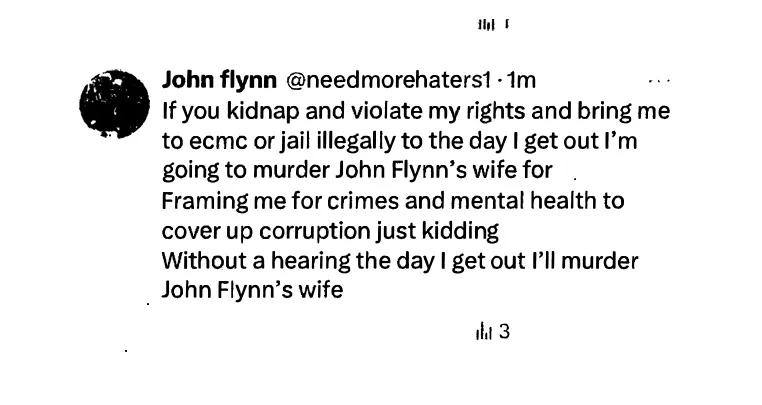
That was the old posture.
The new posture is even worse for the prosecution narrative. The grand jury reportedly did not return the felony true bill. That means the case is no longer a fog bank of accusations, screenshots, orders, jail classifications, and political innuendo. It has narrowed into something much simpler: a misdemeanor false-reporting case that Erie County must now prosecute like a misdemeanor.
The process cannot become the punishment.
Overcharging is not just a courtroom tactic. It is leverage. A felony accusation can destroy a reputation, terrify a defendant, drain resources, and force compliance even if the charge later shrinks or collapses. If prosecutors went looking for a felony and came back with a misdemeanor, the public has a right to ask whether Ryan Flynn was being prosecuted or pressure-cooked.
Tuesday’s arraignment will answer that question fast.
If Flynn is released, the system can say it followed the law after the grand jury narrowed the case. If he is not released, Erie County owes the public a direct explanation. What qualifying offense exists? What statute authorizes detention? What facts make this misdemeanor different?
Because if New York bail law does not protect Ryan Flynn now, then the public is entitled to ask who it really protects.
Is Erie County Crooked?
The grand jury reportedly rejected the felony case against Ryan Flynn. What remains is a misdemeanor false-reporting charge connected to his report about John Flynn. That is the breaking development.
Now Erie County faces the test.
Release him under lawful conditions. Put the misdemeanor on a normal track. Let the state prove its case if it can. Let Ryan Flynn defend himself in open court. But do not pretend a failed felony push still gives the system permission to treat him like a political hostage.
The law either applies to Ryan Flynn or it does not. The administration of justice in New York State is either straight or crooked.
Tuesday will tell the public which Erie County this is.
Related posts:
The Bully Hunter Fraud: Mr. James McGibney's Pay-To-Erase Extortion Machine
TRUMP DROPS KIRK BOMBSHELL: SHOOTER IN CUSTODY
The Lone Juror Who Hung the State
Connecticut Judge Leo Diana: A Conscientious Family Court Jurist Putting Children First
Forbes' Radovan Vítek Problem
Shadows of the Syndicate: The Ken Jowdy Money Trail
About The Author
