New York Politics, Government, Courts, and Characters.
Sign of the Times: Blakeman Plants Flag in MAGA Stronghold
Staten Island launch signals GOP ground war in Hochul showdown.
LUTHMANN COMMENT: This is how it starts. Not in Manhattan studios. Not in Albany press rooms. On a lawn, on Hylan Boulevard, in a neighborhood where people still vote like it matters. Staten Island’s South Shore has always been New York’s political truth serum. The Italian-American vote is shifting right. The Catholic vote is already there. And the Democrats are now carrying the baggage of Mamdani-style policies, whether they admit it or not. Hochul still leads—but the ground is moving. And when the ground moves on Staten Island, the rest of New York eventually feels it. This race just got real. This piece is “Sign of the Times.”
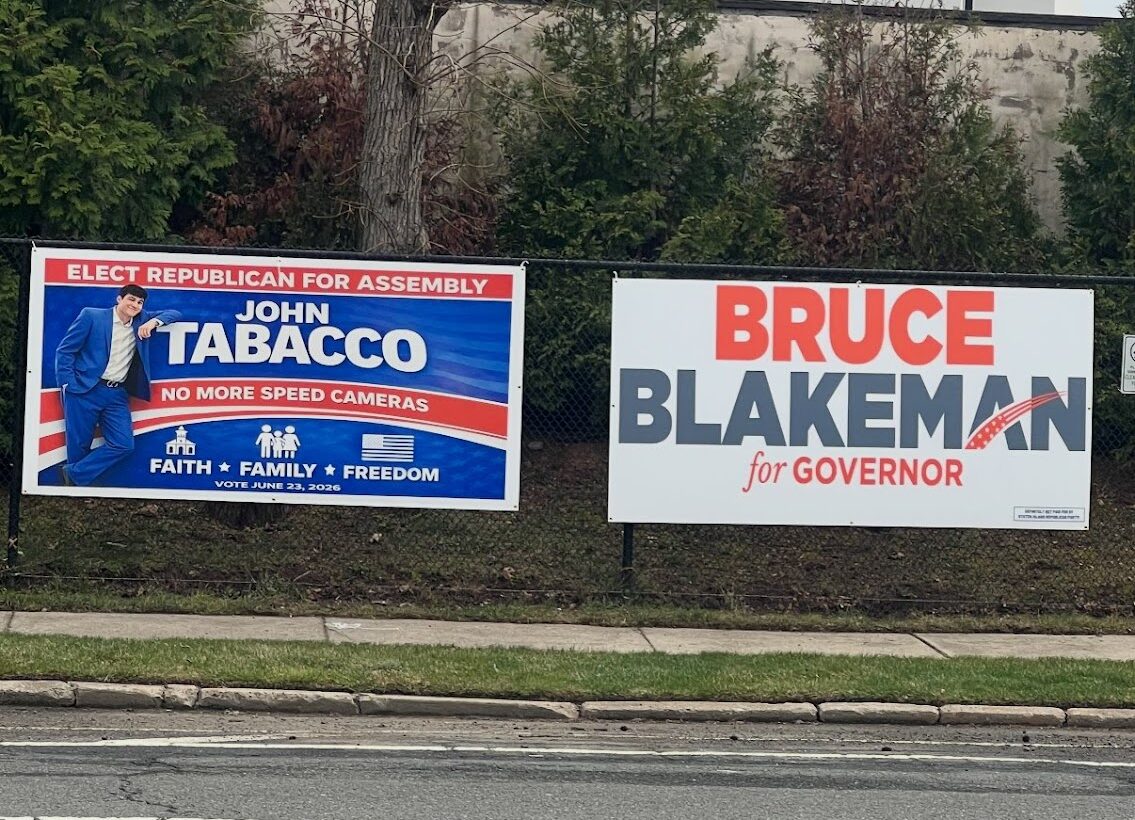
(STATEN ISLAND, NEW YORK) – On Hylan Boulevard, near Page Avenue, where traffic crawls and drivers scan front lawns, a single yard sign just turned into a warning shot. The first “Blakeman for Governor” marker has landed on Staten Island’s South Shore—the reddest turf in New York City and a proven launchpad for Republican momentum. In this neighborhood, signs don’t follow waves. They start them.
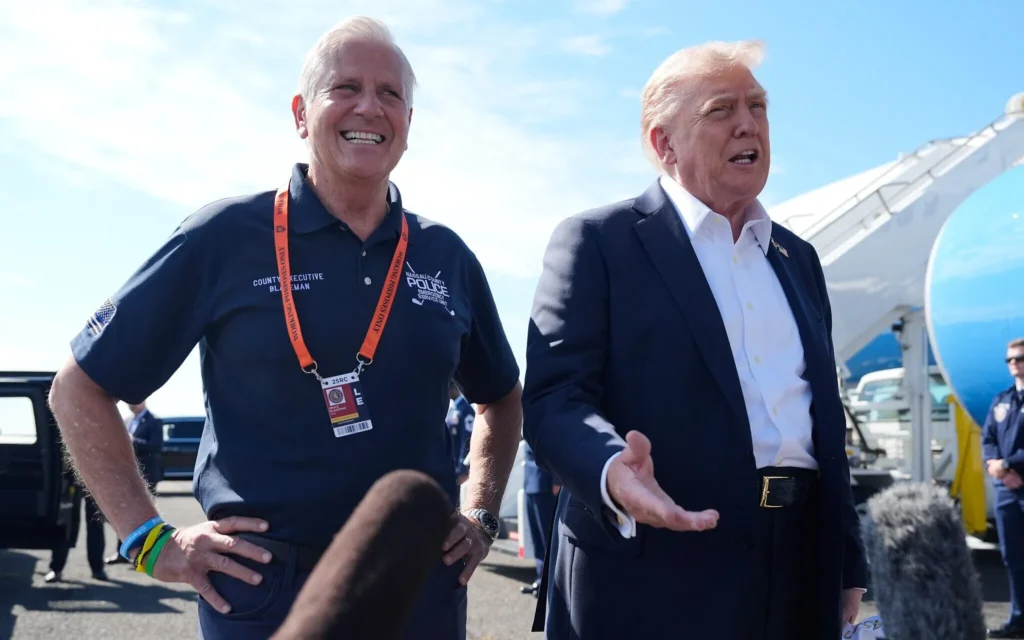
Sign of the Times: Trump Backs Blakeman
This is not a random placement. It is a calculated opening move in a race that will hinge on turnout, tax fatigue, and public safety. The South Shore runs on homeowners, many Italian-Americans, who backed Donald Trump three times and have little patience for Albany’s drift. Their politics are simple and relentless: taxes are too high, crime is too close, and government pushes too far.
Into that pressure zone steps Bruce Blakeman, selling law-and-order, fiscal discipline, and a break from one-party rule. Looming over it all is the “Mamdani effect,” the spread of policies tied to Zohran Mamdani that Republicans say now define the Democratic brand under scandal-plagued Kathy Hochul. On the South Shore, the choice is already framed: suburban stability or urban experimentation. And if history holds, that first sign isn’t the story—it’s the spark.
The Hylan Boulevard Flag
The first marker of a campaign often looks small. On Staten Island’s South Shore, it is anything but. A fresh “Blakeman for Governor” sign now faces traffic along Hylan Boulevard near Page Avenue, planted in a stretch where commuters crawl, and eyes drift to front lawns. The design is built for that moment. “BRUCE BLAKEMAN for GOVERNOR” runs bold, with a stylized, flag-shaped “A” meant to catch attention at speed. It does not whisper. It announces.
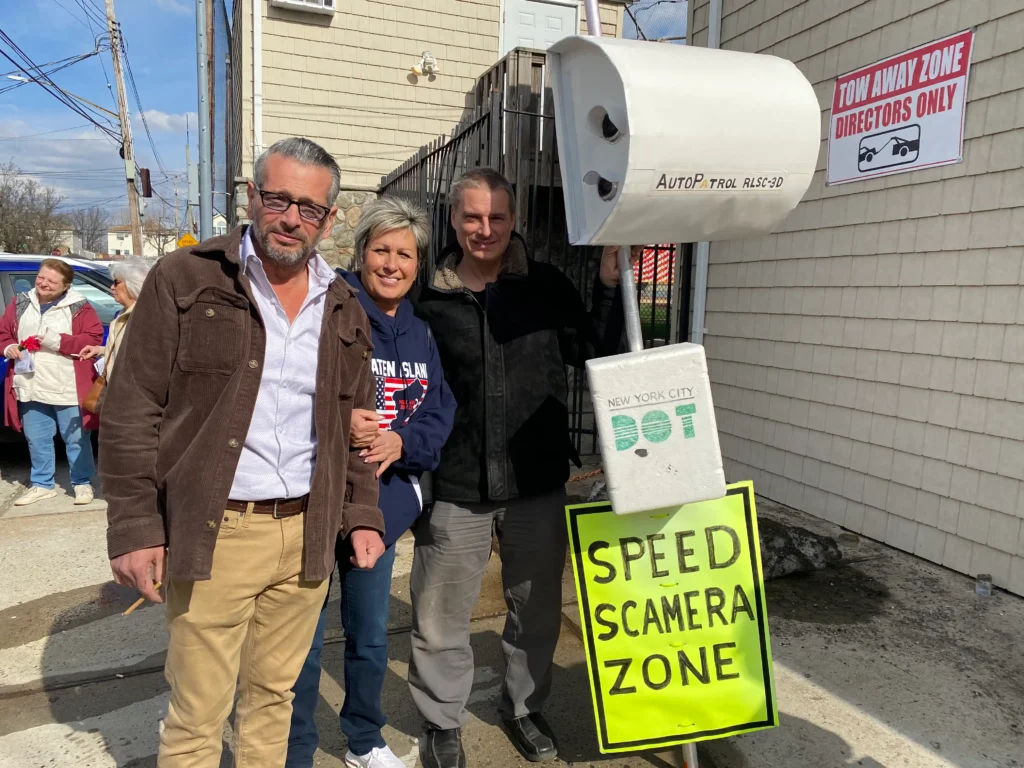
The sign does not stand alone. Inches away sits a second message, a John Tabacco State Assembly sign promising “No More Speed Cameras” and pointing voters to the June 23 primary. Tabacco, son of the former New York City comptroller candidate and current cable news host, taps into the same vein of suburban frustration that animates the Blakeman push. The pairing of the two signs is not random. It is a layered message about taxes, enforcement, and the reach of government into daily life.
Sign of the Times: All politics is local, and one of the biggest issues for Staten Island voters is speed cameras.
At the top of the ticket, Bruce Blakeman is running on a blunt platform forged in Nassau County. He pitches public safety first, no new taxes, and open resistance to Albany mandates, and leans into cultural fights over schools and athletics, framing them as questions of fairness and parental control. His campaign is already pushing supporters to request yard signs and volunteer, signaling a ground game built on visibility and repetition rather than airwaves alone.
The location tells you everything. Hylan Boulevard is the South Shore’s spine. Traffic bunches, lights linger, and drivers look. A name seen once is forgotten. A name seen at every red light becomes real.
That is the math, and veterans of Staten Island politics recognize the pattern. Local GOP clubs treat early signs as marching orders, turning private lawns into public declarations. These signs are not aimed at persuading undecided voters. They are aimed at validators—donors, club leaders, and neighborhood captains who measure momentum by what they can see on their own blocks.
When the first sign appears here, it rarely stays alone. On the South Shore, a single flag can become a field in a matter of days.
Sign of the Times: The South Shore’s Trump Math
Staten Island’s South Shore does not vote like New York City. It votes like a Republican stronghold planted inside it. The numbers out of Richmond County make that clear, cycle after cycle, with margins that would look at home in red counties across the country.
In 2016, Donald Trump pulled 101,437 votes on the Republican and Conservative lines, while Hillary Clinton managed 73,720 on the Democratic and Working Families Party lines. Staten Island stood alone that year—the only borough to break for Trump—signaling a political identity that has only hardened since.
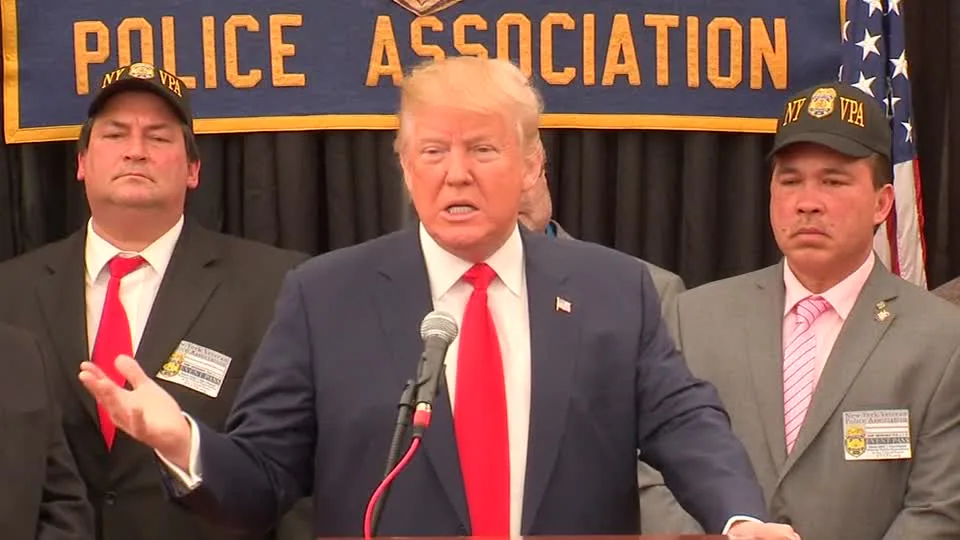
Trump’s Law and Order policies align with the law enforcement-heavy Staten Island.
That pattern held and then expanded. In 2020, Trump increased his total to 123,320 votes, comfortably outpacing Joe Biden, who drew 90,997.
By 2024, the gap widened further. Trump posted 128,151 votes in Richmond County, while Kamala Harris trailed with 69,345. The borough did not just lean Republican—it deepened its commitment. Trump carried three of the four Assembly Districts, turning what was once an outlier into a consistent base of strength.
The engine behind those margins sits on the South Shore. In 2024, Assembly District 62 delivered Trump close to 80 percent of the vote. District 64 cleared 70 percent. District 63 followed suit. Only District 61 showed a Democratic tilt. This is not a mixed map. It is a geographic concentration of Republican power, driven by homeowners, commuters, and families who vote with consistency and turnout discipline. It is why campaigns watch Staten Island not for persuasion, but for proof of momentum.
For Bruce Blakeman, this terrain offers something rare in New York City: friendly ground. For Kathy Hochul, it represents erosion—every vote lost here widens the path Republicans must build statewide. Trump’s December 2025 endorsement of Blakeman only sharpened that dynamic. He called Blakeman “MAGA all the way,” praised his cooperation with U.S. Immigration and Customs Enforcement, and framed him as a “LAW AND ORDER” candidate deserving a “Complete and Total Endorsement.”
Still, the climb remains steep. A recent Siena Research Institute poll shows Hochul leading Blakeman 47% to 34% statewide. Yet the direction matters. The gap has narrowed, independents are trending toward Blakeman, and a large share of voters say they still do not know him. That combination—room to grow, a defined base, and a national endorsement—makes Staten Island’s South Shore more than a local story. It is the foundation of any Republican path forward in New York.
Sign of the Times: The Italian-American Map Behind the Vote
If Bruce Blakeman is building a winning coalition, Staten Island’s Italian-American map is not a side note. It is central. Census-driven analysis continues to mark Richmond County as one of the most concentrated Italian-American populations in the United States. Data compiled by Social Explorer shows the depth of that footprint. Seven of the ten Census tracts nationwide with the highest percentage of Italian ancestry sit inside Richmond County.
Sign of the Times: Staten Island has a large Italian-American voting bloc, particularly on the South Shore.
The scale becomes clearer with city data. The New York City Department of City Planning counted 151,734 Staten Island residents claiming Italian ancestry between 2009 and 2013, out of roughly 586,598 across all five boroughs. That is not just a community. It is a political bloc.
Nowhere is that identity more visible than on the South Shore. It shapes daily life and, by extension, local politics. The culture leans toward ownership, stability, and order. Residents talk about taxes as a constant burden. They talk about schools as a personal stake. They talk about City Hall as something distant and often out of touch. Reporting has long described the South Shore as “more markedly Italian-American,” and has linked that cultural concentration to consistent conservative voting patterns. This is not abstract sociology. It is a lived experience translated into ballots.
The political implications are measurable. Research from the John D. Calandra Italian American Institute cautions that ethnicity alone does not determine voting behavior. Still, its comparisons of Italian-heavy neighborhoods to recent election results show a clear trend: a noticeable shift toward Republicans since 2020.
Italian-American voters are not a swing bloc—they are a quiet backbone of Trump’s coalition. In 2020, he won them outright, taking 51% of the vote according to national survey data. By 2024, that support appears to have grown, tracking with his stronger performance among Catholics—a group that overlaps heavily with Italian-American communities—where he pulled roughly 55% of the vote. The trend line is clear: a steady shift right among working- and middle-class ethnic voters. Among Italian-American men, support runs even deeper, especially in enclaves like Staten Island’s South Shore, where Trump-style politics regularly pushes 70%.
Roger Stone and President Donald J. Trump
Political icon Roger Stone (who had a Sicilian mother) says it best: “Italian-American men are Donald Trump’s strongest voting bloc.”
That overlap—ethnicity, religion, and policy preference—creates political fuel on the South Shore. It turns a yard sign into more than decoration. It becomes a signal within families, within parishes, within neighborhoods where politics is discussed across dinner tables and weekend gatherings. Campaigns understand this. When a candidate gains traction here, it spreads through networks that do not rely on ads or algorithms. On Staten Island’s South Shore, the Italian-American map is not just background. It is the mechanism that moves votes.
Sign of the Times: The Ballot Shadow of Mamdani
Bruce Blakeman is running a simple argument with statewide ambition. He points to his record in Nassau County and asks voters to scale it up. His campaign says he kept streets safe, hired more than 600 law enforcement officers, and held the line on taxes. It says he refused to raise property or sales taxes and worked with U.S. Immigration and Customs Enforcement to push back against sanctuary-style policies. The pitch is clear: what worked in Nassau can work in New York.
Blakeman then turns that record into an indictment of Kathy Hochul. He argues the state has become too expensive and too unsafe under her watch. In a late-March appearance at New York City Hall, he sharpened the message. New York, he said, is “no longer affordable to live” in—and soon may not be “affordable to die” in. It was classic blunt-force campaigning, aimed squarely at voters feeling squeezed by costs and uneasy about public safety.
Sign of the Times: “Commie” Mamdani and Kathy Hochul
But the sharper edge comes from what Republicans now frame as the “Mamdani effect.” Blakeman has tied Hochul directly to the policy orbit of Zohran Mamdani, arguing the governor is aligned with a democratic socialist agenda reshaping the Democratic brand. He has called them “in league together” and labeled Hochul “Comrade Kathy,” while warning that Mamdani’s proposals—particularly on taxes—pose a direct threat to homeowners and the middle class.
Mamdani has not stayed quiet. He has accused Blakeman of importing federal-style immigration enforcement into New York and suggested his approach would lead to aggressive “roundups.” Mamdani openly identifies as a democratic socialist and has pledged to govern that way, drawing a stark ideological contrast that now bleeds into the governor’s race even though he is not on that ballot.
National Republicans see opportunity in that contrast. Reuters has reported that GOP strategists are using Mamdani as a political foil, a symbol of where they argue Democratic governance is headed. The National Republican Congressional Committee has gone further, saying Mamdani effectively “tattoos” Democratic vulnerabilities onto candidates across the 2026 ticket. At the top of that ticket sits Hochul, whether she wants the association or not.
The calendar is set. New York votes on November 3, 2026, with early voting beginning October 24. Between now and then, the arguments will sharpen, the contrasts will harden, and the battle lines will spread outward from places like Staten Island’s South Shore. That is why the sign on Hylan Boulevard matters. It may be small, but it signals a much larger fight—one that will define the direction of New York long after the yard signs come down.
Richard Luthmann is an investigative journalist, media strategist, and political consultant who helps litigants, candidates, whistleblowers, business owners, parents, and public figures turn facts, filings, records, and controversy into powerful media narratives that expose the truth, defend reputations, and fight back.
Consulting and media inquiries: richard.luthmann@protonmail.com or (239) 631-5957.
Links: https://linktr.ee/rluthmann