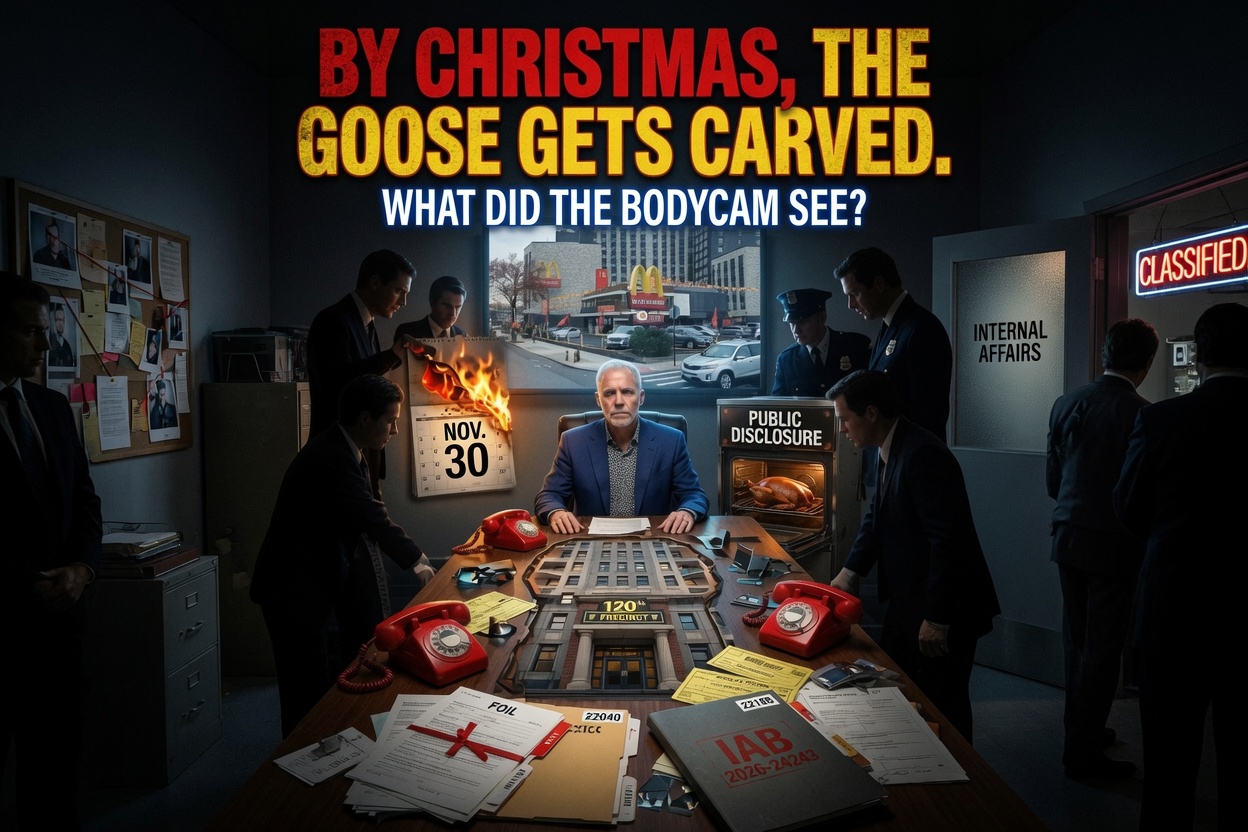
NYPD pushes bodycam response to Nov. 30 as sources say Internal Affairs and Richmond County prosecutors have already reviewed footage from the Bay Street McDonald’s sweep
LUTHMANN NOTE: Kevin Barry Love remains presumed innocent. No public record proves that he bought or sold narcotics, cooperated with law enforcement, or received special treatment. NYC Council Whip Kamillah Hanks and NYPD First Deputy Commissioner Tania Kinsella have not been charged with misconduct. But government cameras are indifferent to political rank, carefully prepared talking points, and disappearing paperwork. The NYPD says it expects to respond to the bodycam request on or about November 30. Sources say Internal Affairs and the Richmond County District Attorney’s Office have already reviewed the footage. If that is accurate, the evidence is not lost or undiscovered. It is sitting inside government systems while officials refuse to explain the basic timeline. The tape may clear everyone. It may show weak evidence, lawful release, mistaken identity, or ordinary police procedure. It may also reveal who called, who arrived, what officers said, and whether Love’s treatment changed after political machinery began moving. November 30 is not the end of this story. It is the opening bell for the disclosure fight. Release the footage. Preserve the vouchers, calls, logs, and communications. By Christmas, let the cameras—not the political class—tell New Yorkers what happened. This piece is “Kevin Barry Love’s Christmas Goose.”

By M. Thomas Nast and Richard Luthmann
The Clock Now Runs To November
(STATEN ISLAND, NEW YORK) – The NYPD has finally put a date on the Kevin Barry Love bodycam mystery, and it lands like a political time bomb: November 30, 2026.

In an acknowledgment sent Friday morning, the Department confirmed receipt of FOIL Request FOIL-2026-056-22040 and said a response could be expected “on or about Monday, November 30, 2026.” The matter has been assigned to Associate Investigator Johnston.
From: donotreply@records.nyc.gov <donotreply@records.nyc.gov>
Date: On Friday, July 17th, 2026 at 9:56 AM
Subject: [OpenRecords] Request FOIL-2026-056-22040 Acknowledged
To: richard.luthmann@protonmail.com <richard.luthmann@protonmail.com>
The New York City Police Department (NYPD) has acknowledged your FOIL request FOIL-2026-056-22040.
You can expect a response on or about Monday, November 30, 2026.
Your request has been assigned to Associate Investigator Johnston (None) of this office.
Please visit FOIL-2026-056-22040 to view additional information and take any necessary action.
That request seeks body-worn-camera footage and related records concerning Love’s reported seizure, detention, transportation, property inventory, and precinct processing following the July 10 narcotics sweep at the McDonald’s at 501 Bay Street on Staten Island.
November may sound like bureaucratic eternity. In politics, it is the blink before the blade falls.
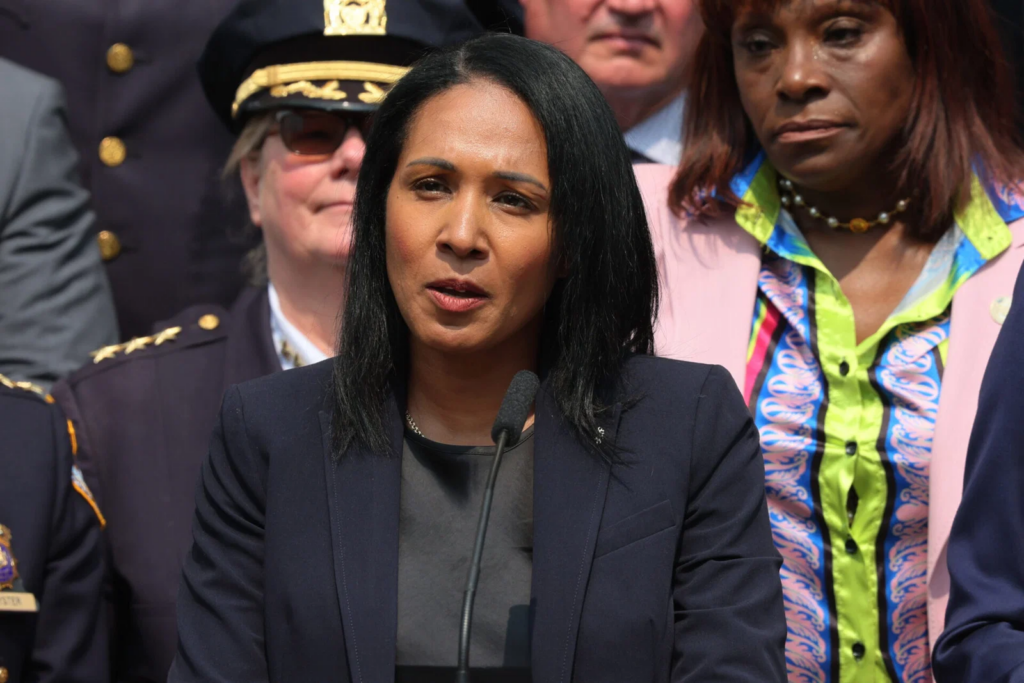
Six months is long enough for administrations to change strategy, witnesses to lawyer up, alliances to fracture, and political protectors to discover sudden amnesia. But it is also a drop-dead window for Love, his wife—New York City Council Majority Whip Kamillah Hanks—First Deputy Commissioner Tania Kinsella, and every official who may have touched the case after Love reportedly entered the 120th Precinct.
By Christmas, the public could see what the cameras saw.
Sources say the NYPD Internal Affairs Bureau and the Richmond County District Attorney’s Office have already reviewed the relevant bodycam footage. That claim has not been independently confirmed by either agency. But if true, the footage is not lost, missing, or undiscovered. It is already known to the institutions now refusing to explain the basic facts.
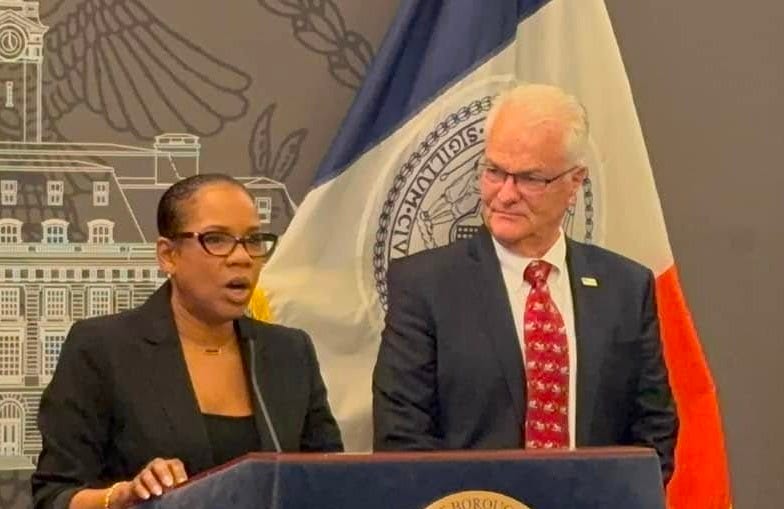
That means the silence is no longer about finding the evidence.
It is about deciding when—and whether—the public gets to see it.
Kevin Barry Love’s Christmas Goose: What The Cameras May Show
The bodycam could settle nearly every major question surrounding Love’s reported detention:
- Did officers approach Love as part of a planned narcotics operation?
- Was he treated as a buyer, seller, witness, target, source, or something else?
- Was he searched? Handcuffed? Questioned?
- Did police recover narcotics, cash, a cellphone, or other property?
- Was he transported to the 120th Precinct and placed in a holding cell? What did he say? What did officers say about him?
- Who called the precinct after he arrived?
Most importantly: How did Kevin Barry Love walk out?
A routine case should produce a routine explanation. Perhaps officers lacked probable cause. Perhaps prosecutors declined charges. Perhaps the suspected substance was not contraband. Perhaps Love received a desk-appearance ticket or release under ordinary rules. Every one of those possibilities can be documented without exposing confidential investigative tactics.
But the silence has created darker possibilities.

Sources previously alleged that Hanks contacted senior NYPD officials after Love was detained, including possible outreach involving Kinsella. Those allegations remain unproven. Internal Affairs nevertheless logged a related complaint under IAB No. 2026-24243, establishing that the Department formally received the claims.
Now sources say Internal Affairs itself has watched the footage.
If that is accurate, IAB already knows whether command-level officers appeared at the precinct, whether telephone calls changed the tone of the encounter, whether officers discussed political pressure, or whether Love received treatment unavailable to an ordinary detainee.
The Richmond County District Attorney’s Office, sources say, has also viewed the footage. If prosecutors saw it, they likely know why Love was detained, what evidence existed, and why no public prosecution trail has surfaced.
The bodycam may exonerate everyone.
It may also show exactly where the machinery began moving.
Kevin Barry Love’s Christmas Goose: Six Months Is A Political Eternity
The November deadline creates danger for every public figure connected to this story because it freezes the issue in place through the summer, fall, and election season.
Hanks cannot credibly pretend the matter will evaporate. Kinsella cannot assume the chain of command will remain hidden forever. The 120th Precinct cannot rely on vague references to an active matter while footage, logs, vouchers, and dispatch records sit inside government systems. Richmond County District Attorney Michael McMahon’s office cannot indefinitely avoid saying whether Love was presented for prosecution, treated as a witness, or connected to a sealed proceeding.


The delay gives everyone time to prepare explanations. It also gives journalists time to test them.
Two FOIL filings now target the record trail. The original request seeks the bodycam, arrest records, property vouchers, precinct video, dispatch traffic, and communications. The amended request, FOIL-2026-056-22186, corrects the incident date to July 10 and demands records from the alleged narcotics sweep, including arrest-team rosters, operation plans, prisoner lists, court references, evidence handling, prosecutor communications, and any record showing whether Love was treated as a defendant, target, witness, confidential informant, or cooperating source.
The government may invoke exemptions. It may redact faces, private data, confidential techniques, or active-investigation material. What it cannot lawfully do is convert every record into a black hole merely because the subject is politically connected.
And politically, November 30 is not the end. It is the beginning of the disclosure fight.
If the NYPD produces footage, the public will examine every frame. If it withholds the footage, the exemption will be challenged. If it claims no footage exists, the Department will have to explain how sources say IAB and prosecutors already reviewed it.
By then, every inconsistency becomes evidence of its own.
Kevin Barry Love’s Christmas Goose: Will Kevin Get Carved?
Kevin Barry Love remains presumed innocent. No public record presently proves that he possessed narcotics, purchased narcotics, sold narcotics, cooperated with law enforcement, or received political favors. Hanks and Kinsella have not been charged with misconduct. Source claims require corroboration, and the bodycam could destroy the entire theory of preferential treatment.
But that is precisely why the footage matters.
If Love was merely caught in the wrong place, release the relevant video and clear his name. If officers detained him without sufficient grounds, say so. If prosecutors declined a weak case, disclose the administrative disposition. If Love entered treatment, his private medical information should remain private—but the legal basis for police custody does not disappear. If he cooperated with authorities, the government may protect legitimate confidential information while still accounting for the public exercise of police power.
What cannot continue is the fiction that nothing happened.
A man was reportedly swept into a narcotics operation, transported to a precinct, placed in a cell, and had his property vouchered. Then the public trail went dark. A sealed docket surfaced. Press questions went unanswered. Internal Affairs logged a complaint. Two FOIL requests followed. Now the NYPD has admitted the records process will run until the doorstep of December.
That date belongs on every political calendar in Staten Island.
By Christmas, Kevin Barry Love’s goose may be cooked—not because reporters declared him guilty, but because government cameras do not care who his wife is, who called whom, or what story political operatives agreed to tell afterward.
The footage either supports the official silence or exposes it.
Release the bodycam. Preserve every record. Let the tape speak.
Related posts:
A Peculiar Substitution of Judge in New York Supreme Court, and the Administrative Judge Quickly Act…
Flynn Freed After Felony Flop
THE UNKNOWN PODCAST 40: CURRENT EVENTS – TRUMP'S BIG BEAUTIFUL BILL, TARIFFS, PARDONS, AND A BOMBSHE…
J. Gary DiLaura Op-Ed: An Open Letter to FBI Director Kash Patel
NONE DARE CALL IT TREASON…WANNA BET?
McMahon’s Fear Fraud Scandal: Felony Free Speech or Perjury by a Politician?
About The Author
