

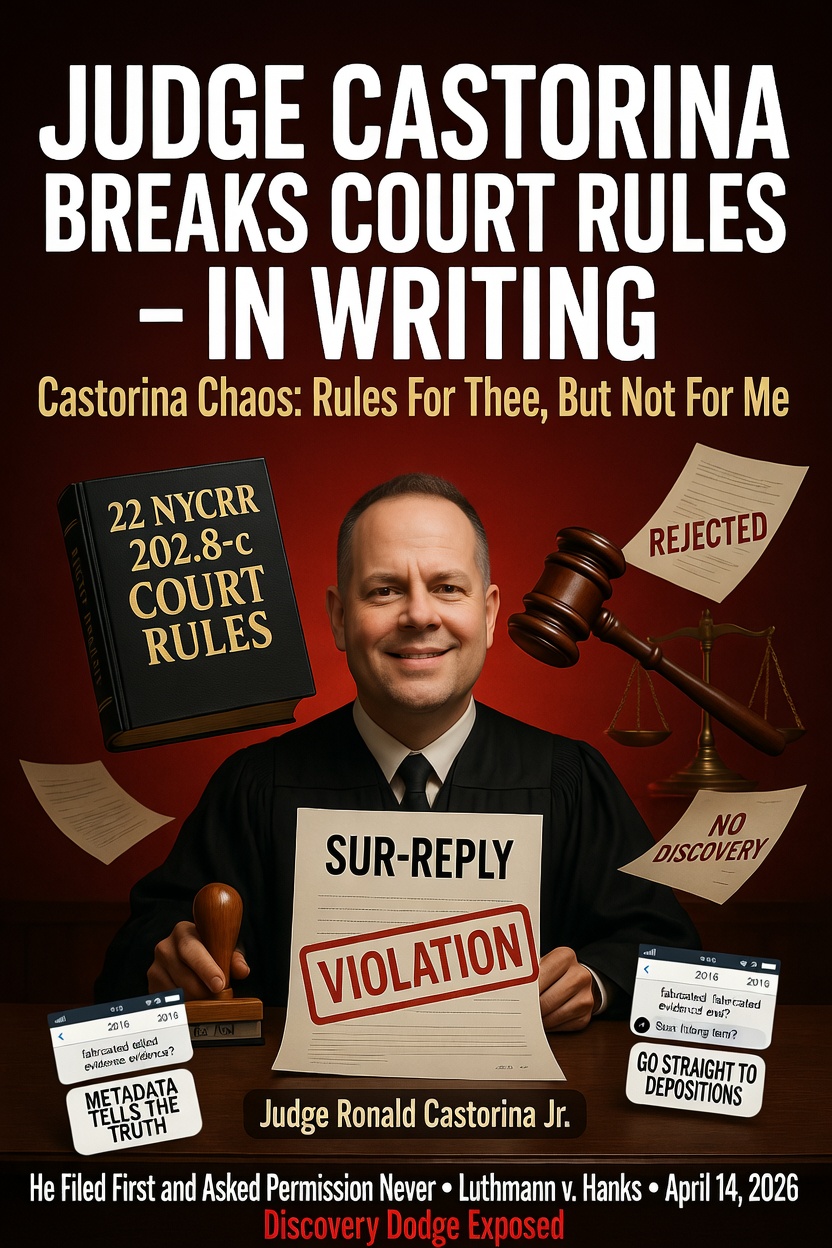
Castorina Chaos: Rules For Thee, But Not For Me
LUTHMANN NOTE: This is where the crooked New York judicial-political system shows its hand. When a sitting judge admits he filed without permission, the question is not technical—it’s structural. Who follows the rules, and who bends them? Castorina’s move wasn’t just aggressive. It exposed the playbook: delay, deflect, and avoid discovery. But once “fabrication” gets thrown around, there’s only one way forward—produce everything. Metadata. Devices. Depositions. Under oath. That’s the line they don’t want to cross. Because once testimony starts, narratives collapse. This case isn’t about paperwork anymore. It’s about who’s willing to tell the truth when the record stops being optional. This piece is “Judge Castorina Breaks Court Rules.”

By Rick LaRivière with Richard Luthmann
Judge Castorina Breaks Court Rules: He Filed First and Asked Permission Never
Staten Island Judge Ronald Castorina Jr. just gave Richard Luthmann a new headline and a new court paper. In the latest turn of Luthmann v. Hanks, Castorina, a defendant in a Manhattan civil case, filed a sur-reply on April 14 that openly admitted it was submitted without prior court authorization.
The first page says it in black and white: “I understand that I have not received prior authorization from the Court to file a sur-reply brief.”

Luthmann immediately answered with a Notice of Rejection, filed the same day, arguing the paper violates 22 NYCRR 202.8-c and should not be read at all. The rejection notice says sur-replies are barred absent advance leave, and materials filed in violation “will not be read or considered.”
“In New York Supreme Court, you don’t get to make it up as you go. Unauthorized papers don’t get read. That’s not my opinion—that’s the rule book,” Luthmann said. “Judge Ron apparently thinks the rules don’t apply to him.”
Luthmann also cites BAC Home Loans Servicing, LP v. Uvino, 155 A.D.3d 1155 (3d Dep’t 2017), and U.S. Bank Trust, N.A. v. Rudick, 156 A.D.3d 841 (2d Dep’t 2017), for the point that unauthorized surreplies are improper and generally disregarded.
That is the procedural bomb. But the real story is the substance. Castorina’s sur-reply did not engage the main recusal issue. Luthmann’s pending motion asks whether Justice Emily Morales-Minerva should step aside because her household is tied to the Manhattan Democratic machine through her husband, Party Chair Nico Minerva.
Luthmann’s April 13 Reply Affidavit framed the question as judge-centric. He argued that one prior judge, Justice Brendan Lantry, already recused on appearance grounds in the same case and that the current assignment carries even worse optics. He said the case has pinballed across judges and been kept above discovery for years.
Castorina went another way. He attacked one exhibit and the plaintiff’s credibility. He claimed it was “impossible” for messages from August 2016 to identify him as “Judge Ronald Castorina, Jr.” because he did not become a judge until 2021. He asked the court to take judicial notice of his 2020 election and later swearing-in, then argued the exhibit was “clearly altered,” “demonstrably fabricated,” and sanctionable.
Luthmann answered that point by saying the label proves nothing except how e-discovery works.
“This isn’t a mystery. It’s e-discovery. Files get compiled by e-discovery vendors. Labels get updated as of the time of the compilation—when Ron was already a judge and after I got out of the hoosegow,” Luthmann said. “The raw data tells the truth—and that’s exactly what they don’t want produced. But ouuh baby, I like it raw.”
The Notice of Rejection says the “Judge” honorific was entered during later compilation by an e-discovery vendor after Castorina had taken the bench and after Luthmann left federal prison on April 5, 2021, and federal custody on August 5, 2021. Luthmann says the software prompted for participant identifiers, and they were entered truthfully as of the compilation date. That, he argues, does not make the underlying 2016 messages fake. It makes them compiled.
“To think that a sitting New York State Justice doesn’t know the distinction is scary,” Luthmann said. “I guess that’s DEI at work.”
Judge Castorina Breaks Court Rules: The Sur-Reply That Proved the Need for Discovery
Luthmann’s answer to Castorina is blunt. Thank you for proving the case belongs in discovery.
“You don’t litigate authenticity in a rogue sur-reply. You litigate it in discovery—with documents, metadata, and sworn testimony,” Luthmann said. “This case has been trapped above discovery for years. That’s not a coincidence, it’s by design.”

His Notice of Rejection says that if Castorina wants to litigate authenticity, then the remedy is not an unauthorized side-brief. It is raw exports, metadata, vendor logs, source files, and sworn depositions. The filing cites CPLR 3101(a) for broad disclosure and points to Forman v. Henkin, 30 N.Y.3d 656 (2018), for the principle that ordinary material-and-necessary rules govern electronic discovery.
Luthmann asks for an immediate discovery conference and a prompt ESI order because no discovery has been exchanged yet.
That is where Castorina may have overplayed his hand. By crying fabrication, he turned a motion fight into an authenticity fight. By doing it without leave, he handed Luthmann a procedural opening. And by centering the dispute on a compiled label instead of the recusal standard, he strengthened Luthmann’s argument that Castorina is trying to keep the case away from depositions.
Luthmann’s April 13 affidavit said exactly that. He called Castorina’s earlier opposition a “self-serving smoke screen” designed to keep the case trapped above discovery, where nobody has to sit under oath, and no one has to make admissions on videotape.
“Seven judges. Three years. No discovery. At some point, it stops looking like a delay and starts looking like a protection racket, and a clumsy one at that.” Luthmann said.
The record makes the next part worse for Castorina. The exhibit he now calls impossible is not some stray internet scrap. The Albany filing attached to the latest papers contains exported Facebook Messenger messages labeled “Messages exported from: Richard Luthmann” and “With: Judge Ron Castorina Jr.” stretching back years. Those exports include political chatter, campaign strategy talk, and exchanges about Janine Materna.
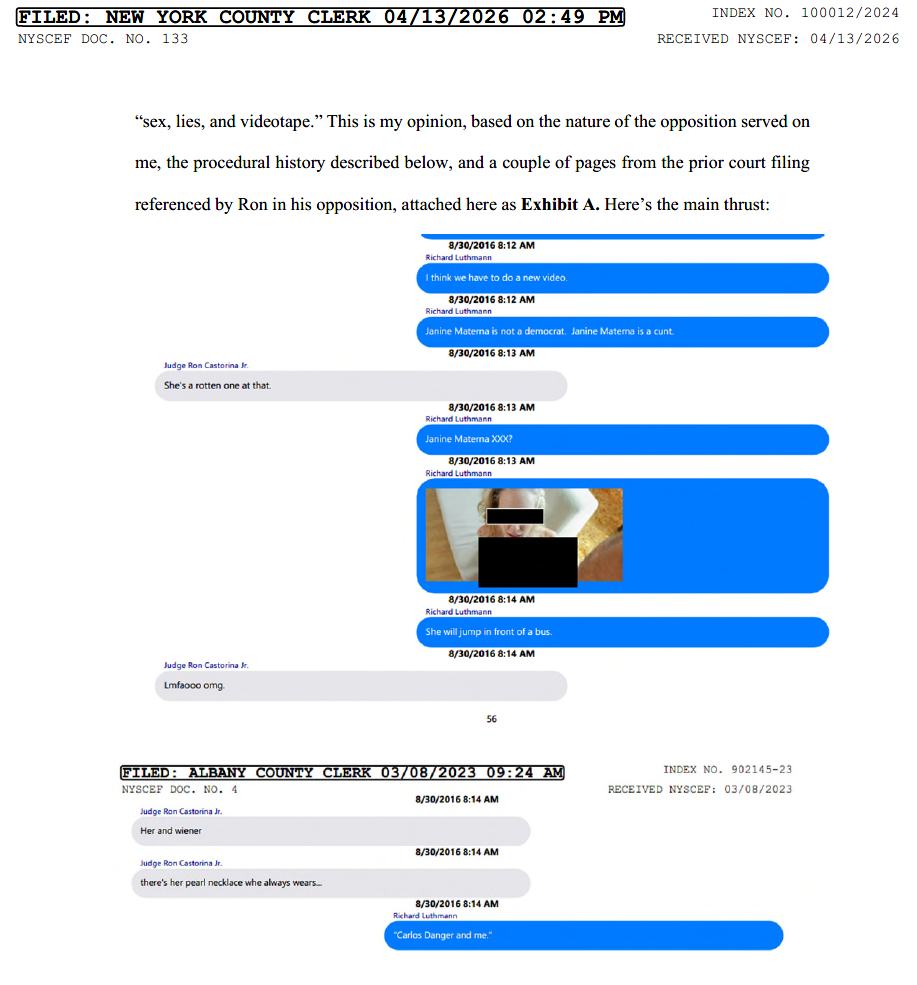
On pages 56 and 57 of the export, August 30, 2016 messages show Luthmann sending vulgar material about Materna and Castorina responding with crude comments, including “She’s a rotten [expletive] at that,” “Her and weiner,” and “there’s her pearl necklace [she] always wears…” before later saying he would “win on the merits” because “she’s a terrible person and a horrible candidate.”
Luthmann’s April 13 Reply Affidavit reproduced those same exchanges as Exhibit A. On pages 13 and 14 of that filing, screenshots show the same Messenger thread and the same crude references to a woman.
Judge Castorina previously authenticated these Messenger messages when he sat for a grand jury deposition in 2018, so to deny them now would create a perjury problem.
“Thank you, Judge Castorina. You just proved exactly why this case needs discovery—immediately,” Luthmann said. “Do not pass go. Do not collect $200. Go straight to depositions.”
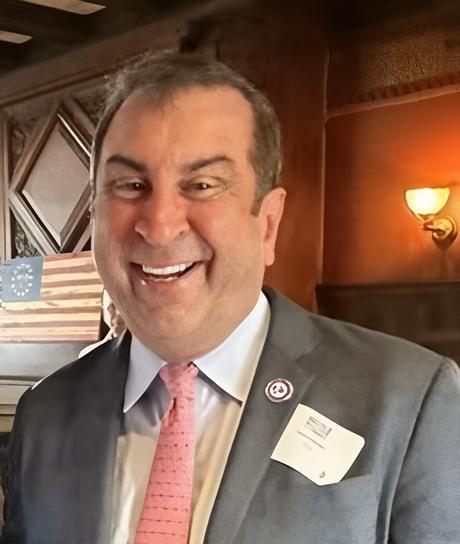
We asked Judge Castorina, his lawyer Robert Brown, about the Sur Reply, copying NYS Courts press offices and supervising judges, City Hall, Council Speaker Julie Menin, Majority Whip and co-defendant Kamillah Hanks, DSA addresses, and others. Here is what we asked:
From: Rick LaRivière <RickLaRiviere@proton.me>
Date: On Tuesday, April 14th, 2026 at 2:48 PM
Subject: PRESS INQUIRY: Unauthorized Sur-Reply, Alleged Fabrication Claims, and Discovery Avoidance in Luthmann v. Hanks
To: rcastori@nycourts.gov <rcastori@nycourts.gov>, rbrown@robertbrownlaw.com <rbrown@robertbrownlaw.com>, michelle@robertbrownlaw.com <michelle@robertbrownlaw.com>, admin@robertbrownlaw.com <admin@robertbrownlaw.com>, aohandley@robertbrownlaw.com <aohandley@robertbrownlaw.com>, AHackel@nycourts.gov <AHackel@nycourts.gov>, press@nycourts.gov <press@nycourts.gov>, publicinformation@nycourts.gov <publicinformation@nycourts.gov>, wilsonchambers@nycourts.gov <wilsonchambers@nycourts.gov>, SFC-Part42-Clerk@nycourts.gov <SFC-Part42-Clerk@nycourts.gov>, drenwick@nycourts.gov <drenwick@nycourts.gov>, Jmenin@council.nyc.gov <Jmenin@council.nyc.gov>, SpeakerMenin@council.nyc.gov <SpeakerMenin@council.nyc.gov>, district49@council.nyc.gov <district49@council.nyc.gov>, DCarr@council.nyc.gov <DCarr@council.nyc.gov>, Ahart@council.nyc.gov <Ahart@council.nyc.gov>, Pverma@council.nyc.gov <Pverma@council.nyc.gov>, District20@council.nyc.gov <District20@council.nyc.gov>, District27@council.nyc.gov <District27@council.nyc.gov>, District51@council.nyc.gov <District51@council.nyc.gov>, District7@council.nyc.gov <District7@council.nyc.gov>, SpeakerScheduling@council.nyc.gov <SpeakerScheduling@council.nyc.gov>, info@council.nyc.gov <info@council.nyc.gov>, EEOOfficer@council.nyc.gov <EEOOfficer@council.nyc.gov>, Morano@council.nyc.gov <Morano@council.nyc.gov>, hearings@council.nyc.gov <hearings@council.nyc.gov>
CC: Michael Volpe <mvolpe998@gmail.com>, Frankie Pressman <frankiepressman@protonmail.com>, Frank Parlato <frankparlato@gmail.com>, Modern Thomas Nast <mthomasnast@protonmail.com>, RickLaRiviere@proton.me <RickLaRiviere@proton.me>, Richard Luthmann <richard.luthmann@protonmail.com>, RALafontaine@protonmail.com <ralafontaine@protonmail.com>, socialist.feminism@socialists.nyc <socialist.feminism@socialists.nyc>, labor@socialists.nyc <labor@socialists.nyc>, ella@nycdsa.org <ella@nycdsa.org>, press@revenuecampaign.org <press@revenuecampaign.org>, fclark@pscmail.org <fclark@pscmail.org>, lower.manhattan@socialists.nyc <lower.manhattan@socialists.nyc>, steering@socialists.nyc <steering@socialists.nyc>, info@socialists.nyc <info@socialists.nyc>, mediation@socialists.nyc <mediation@socialists.nyc>, grievance@socialists.nyc <grievance@socialists.nyc>, steering@socialists.nyc <steering@socialists.nyc>, endorsements@socialists.nyc <endorsements@socialists.nyc>, ella@nycdsa.org <ella@nycdsa.org>, political.education@socialists.nyc <political.education@socialists.nyc>, sumaya@adalahjusticeproject.org <sumaya@adalahjusticeproject.org>, press@socialists.nyc <press@socialists.nyc>, press@socialists.nyc <press@socialists.nyc>, AYaskova@cityhall.nyc.gov <AYaskova@cityhall.nyc.gov>, judiciary@cityhall.nyc.gov <judiciary@cityhall.nyc.gov>, mayor@cityhall.nyc.gov <mayor@cityhall.nyc.gov>, PressOffice@cityhall.nyc.gov <PressOffice@cityhall.nyc.gov>
Judge Castorina and Mr. Brown,
We are preparing a follow-up publication regarding your recently filed “Sur-Reply” (NYSCEF Doc. 134) and the subsequent Notice of Rejection (Doc. 135) in Luthmann v. Hanks, which is presently pending in New York County Supreme Court. We are requesting your response to the following issues, which go directly to credibility, judicial ethics, and whether this case will ever reach discovery.
Your filing explicitly admits it was submitted without prior court authorization. Under 22 NYCRR 202.8-c, such submissions “will not be read or considered.”
The recusal motion now sits squarely in the middle of a full-blown civil war inside New York’s Democratic Party, where insurgent Democratic Socialists of America forces are pushing to dismantle the old Manhattan machine long controlled by Party Chair Nico Minerva—the husband of Justice Emily Morales-Minerva—and the loyal network surrounding longtime power broker Keith Wright. This is not theoretical politics. It is trench warfare over control of judicial nominations, party infrastructure, and institutional power. Every major player in this case exists within that ecosystem. Minerva operates at the center of the county apparatus. Wright remains the architect of the old guard’s influence. And the emerging DSA-aligned faction is openly targeting that structure for replacement.
Julie Menin, as Speaker of the New York City Council, and Kamillah Hanks, as Majority Whip, hold two of the most powerful leadership posts in city government—and both operate within the Manhattan Democratic Party apparatus that drives endorsements, committee assignments, and legislative priorities. That apparatus, long controlled by Minerva and Wright, functions as the gatekeeper for political advancement in New York City, effectively shaping who rises, who falls, and how City Hall operates. In practice, the Manhattan Democratic organization’s influence extends far beyond county politics, reaching directly into the Council’s leadership structure and the broader machinery of city governance, where factional party loyalty and alignment often determine access, authority, and outcomes.
Against that backdrop, the optics of a recusal motion involving a judge whose household is tied to the very machine under political siege are combustible. Whether intentional or not, the case now reads less like routine litigation and more like a proxy battle between competing Democratic factions, where the outcome—especially whether discovery ever happens—could expose not just one dispute, but the inner workings of an entire political system.
Additionally, Judge Castorina’s filings pointedly sidestep the only question that matters—whether Justice Morales-Minerva’s continued role creates an appearance of impropriety—and instead veer into a scattershot attack on exhibits and the plaintiff’s credibility. That omission is telling. Rather than engage the judge-centric recusal standard, his sur-reply reads like a defense brief for himself, raising allegations of “fabrication” while ignoring the ethical optics that triggered the motion in the first place. Compounding the problem, the record now includes language attributed to Castorina in the Messenger exchanges—crude, demeaning remarks about a woman—already authenticated by his earlier 2018 grand jury testimony—raising serious concerns about bias and temperament of a sitting NYS Supreme Court Justice.
https://iapps.courts.state.ny.us/nyscef/ViewDocument?docIndex=0zKVsbghJ1SmbPIMtvX/Ng==
In that light, the filing looks less like a good-faith response on recusal and more like an attempt to change the subject away from political entanglements and toward collateral disputes. For most, it reinforces a broader worry: that a defendant who is also a sitting judge is using motion practice to deflect scrutiny, avoid discovery, and keep the focus off questions about judicial integrity, bias, and the kind of rhetoric that has no place in a courtroom.
With that being said:
1. Why did you file a sur-reply without leave of court in violation of the Uniform Rules?
2. Do you believe judges—and litigants—should be allowed to bypass procedural rules when they claim “urgency”?
3. Are you asking the Court to consider your filing despite acknowledging it was unauthorized?
Your sur-reply claims that Facebook Messenger Messages between Judge Castorina and Richard Luthmann are “demonstrably fabricated” because you were not a judge in 2016
4. Are you aware that the Notice of Rejection explains the labeling resulted from e-discovery compilation after your elevation to the bench?
5. Do you dispute that e-discovery vendors commonly assign participant identifiers based on current status at the time of compilation?
6. Do you have any evidence that the underlying messages themselves are not authentic?
7. Will you agree to produce your own devices, accounts, and records in discovery to test authenticity?
The Notice of Rejection argues your filing actually confirms this case must proceed to discovery, including metadata, raw exports, and depositions.
8. Do you concede that disputes over authenticity are properly resolved through discovery, not motion practice?
9. Will you agree—on the record—that this case should proceed immediately to depositions and full ESI production?
10. If not, what are you trying to avoid?
Your filing seeks to strike Exhibit A entirely as “impossible” and suggests sanctionable conduct.
11. Are you accusing a litigant of fraud while simultaneously resisting discovery that could confirm or refute your claim?
12. Why not welcome discovery if you are confident the evidence is fabricated?
The Notice of Rejection also raises a broader issue: whether your arguments are a “Luthmann-centric” distraction from a judge-centric recusal issue.
13. Do you concede that recusal is judged based on the presiding judge’s circumstances—not the plaintiff’s past?
14. If so, why does your filing focus almost entirely on attacking Luthmann instead of addressing the Morales-Minerva conflict?
Additionally, the filing highlights language attributed to you in the Messenger exchanges, including statements referencing women in derogatory terms (see Exhibit A images, pp. 13–14 of Reply Affidavit).
15. Do you deny making those statements?
16. Do you believe those statements reflect appropriate conduct for a sitting judge?
17. Do you believe they demonstrate bias—particularly toward women?
18. Are you aware that the Notice characterizes this as evidence of “disdain” for certain groups, including e-discovery vendors and women?
Finally, the broader question:
19. Are you biased in this case as a named defendant opposing discovery into your own conduct?
20. Do you believe it is appropriate for a sitting judge to litigate in a case where discovery could involve his own sworn testimony?
21. Should the public trust a system where a defendant judge files unauthorized papers, alleges fabrication, and resists discovery?
This story will address whether the courts are functioning as neutral tribunals—or as protective barriers for insiders avoiding sworn testimony.
Please provide any response ASAP – as we are about to go to press. If you respond after press time, we will incorporate your responses into a follow-up.
Thanks,
Rick LaRivière
Independent Journalist
(239) 766-5800
Follow Me On Substack
Sent with Proton Mail secure email.
 |
New York County Supreme Court
|
The NYSCEF System has received the documents listed below from filing user Richard Luthmann . Please keep this notice as a confirmation of this filing.
Case Information
Index #: 100012/2024
Caption: RICHARD A. LUTHMANN v. KAMILLAH M. HANKS et al
eFiling Status: Partial Participation Recorded
Assigned Case Judge: Emily Morales-Minerva
Documents Received
| Doc # | Document | Received Date |
|---|---|---|
| 135 | NOTICE OF REJECTION Motion #: 006 |
04/14/2026 |
E-mail Service Notifications Sent
| Name | Email Address |
|---|---|
| ALEXANDER P MCBRIDE | apm@dhclegal.com |
| ROBERT EDWARD BROWN | rbrown@robertbrownlaw.com |
| CHARLES CAPETANAKIS | cc@dhclegal.com |
| MATTHEW CHARLES HARNISCH | mch@dhclegal.com |
| KAROL SKRZYPA | kskrzypa@law.nyc.gov |
| Richard Luthmann | richard.luthmann@protonmail.com |
In a nutshell, the inquiry asked why Castorina filed without leave, whether he expected the court to read unauthorized papers, whether he would agree to full ESI discovery, whether the statements attributed to him reflected bias toward women, and whether the public should trust a system where a defendant judge files unauthorized papers while resisting discovery.
As of press time, we receive no response from the sitting NYS Supreme Court Justice or any of his representatives.
Judge Castorina Breaks Court Rules: The Political War Behind the Rule Violation
This is not a dry motion-practice spat. It sits inside a larger political brawl. Luthmann’s recusal papers say the Manhattan Democratic Party is in trench warfare between the old Keith Wright machine and the insurgent Democratic Socialists. He names Nico Minerva, husband of Justice Morales-Minerva, as the county chair tied to that old apparatus.
He places Speaker Julie Menin and Council Majority Whip Kamillah Hanks inside the same leadership structure that reaches from county endorsements into City Hall. Luthmann argues that the case now reads like a proxy war inside a party machine because discovery could expose how political power, judicial screening, and institutional protection work in real life.

That backdrop matters because Castorina’s sur-reply never really touched it, never answering whether a judge whose spouse runs Manhattan Democratic operations should preside over a case involving party insiders. It never answered why this matter has bounced through judges and still has not reached discovery. And it never answered why a prior judge recused but the current one has not.
Instead, it ran straight at one label on one exhibit and used that as a springboard to accuse Luthmann of “fraud.”
Luthmann seized on that omission in the Notice of Rejection. He wrote that the filing is a detour into “Luthmann-centric” rhetoric, not the “judge-centric” appearance-of-impropriety question that is actually before the court.
Castorina’s filing “pointedly sidesteps the only question that matters” and instead veers into attacks on exhibits and the plaintiff’s credibility. It says the omission is telling. It says the filing looks less like a good-faith response on recusal and more like an attempt to change the subject away from political entanglements and toward collateral disputes.
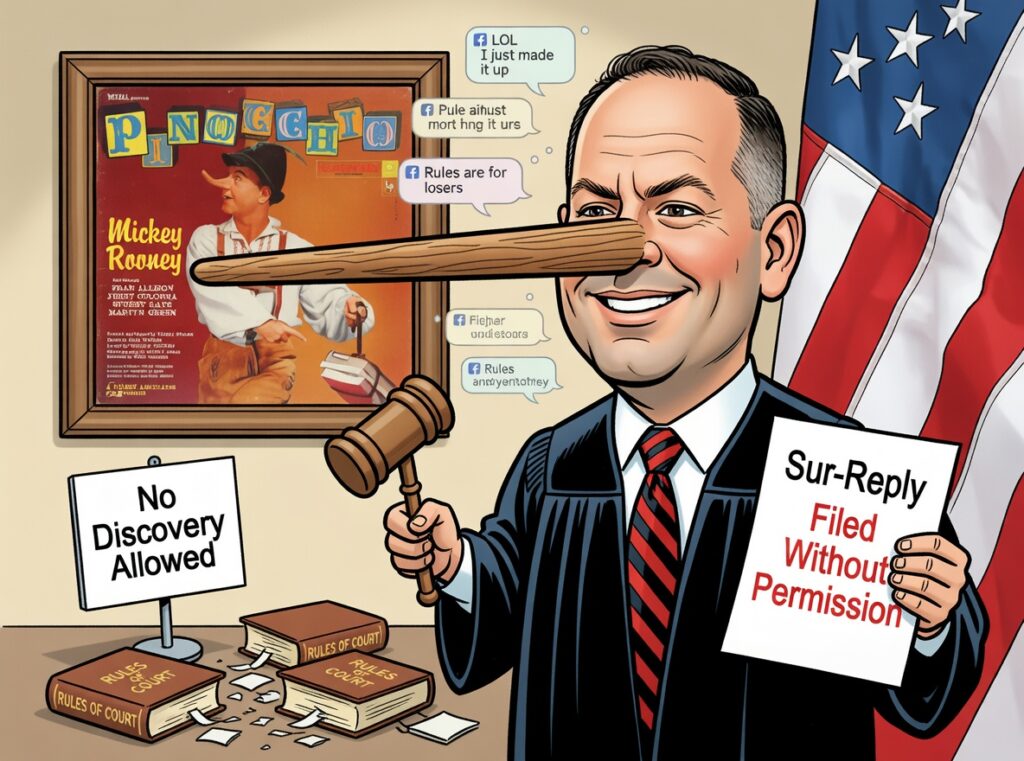
That is now the headline. A sitting judge who is also a named defendant filed a sur-reply he admits was unauthorized. He then used that paper to cry fabrication over a label dispute that the opposing side says is explained by routine e-discovery assembly and can be tested through metadata.
Luthmann’s answer is pure hardball. Reject the paper. Read the rules. And move this case to discovery right now.
“A sitting judge who is also a defendant doesn’t get to rewrite the rules to protect himself,” Luthmann said. “He ignored recusal. He ignored the optics. He ignored the law. And now he wants the Court to ignore his own admissions? Give me a break. I’ve seen it rain bullshit, but never in chunks this big.”
If Castorina is confident, let him produce the records, sit for deposition, and prove it. He already did it before a 2018 grand jury.
If not, the public can draw its own conclusion about why a defendant judge would violate court rules just to avoid the regular machinery of civil justice.






About The Author
