
The Unknown Podcast Takes On The Libel Battlefield as Three Lawsuits Expose Media’s Legal Fault Lines
LUTHMANN NOTE: Here’s the reality nobody wants to say out loud: journalism today is playing with fire. The Blaze case shows what happens when verification collapses. The Patel case shows how hard it is for powerful figures to fight back. And the Loomer case? That’s what happens when people confuse jokes with lawsuits. The courts are becoming the cleanup crew for a broken media ecosystem. But they’re not designed for that. If reporters don’t tighten standards—and if plaintiffs keep filing weak cases—you’re going to see more chaos, more costs, and more chilling effects on speech. Truth isn’t optional. It’s the whole game. This piece is “Defamation Wars Erupt.”


By Frankie Pressman with Michael Volpe and Richard Luthmann
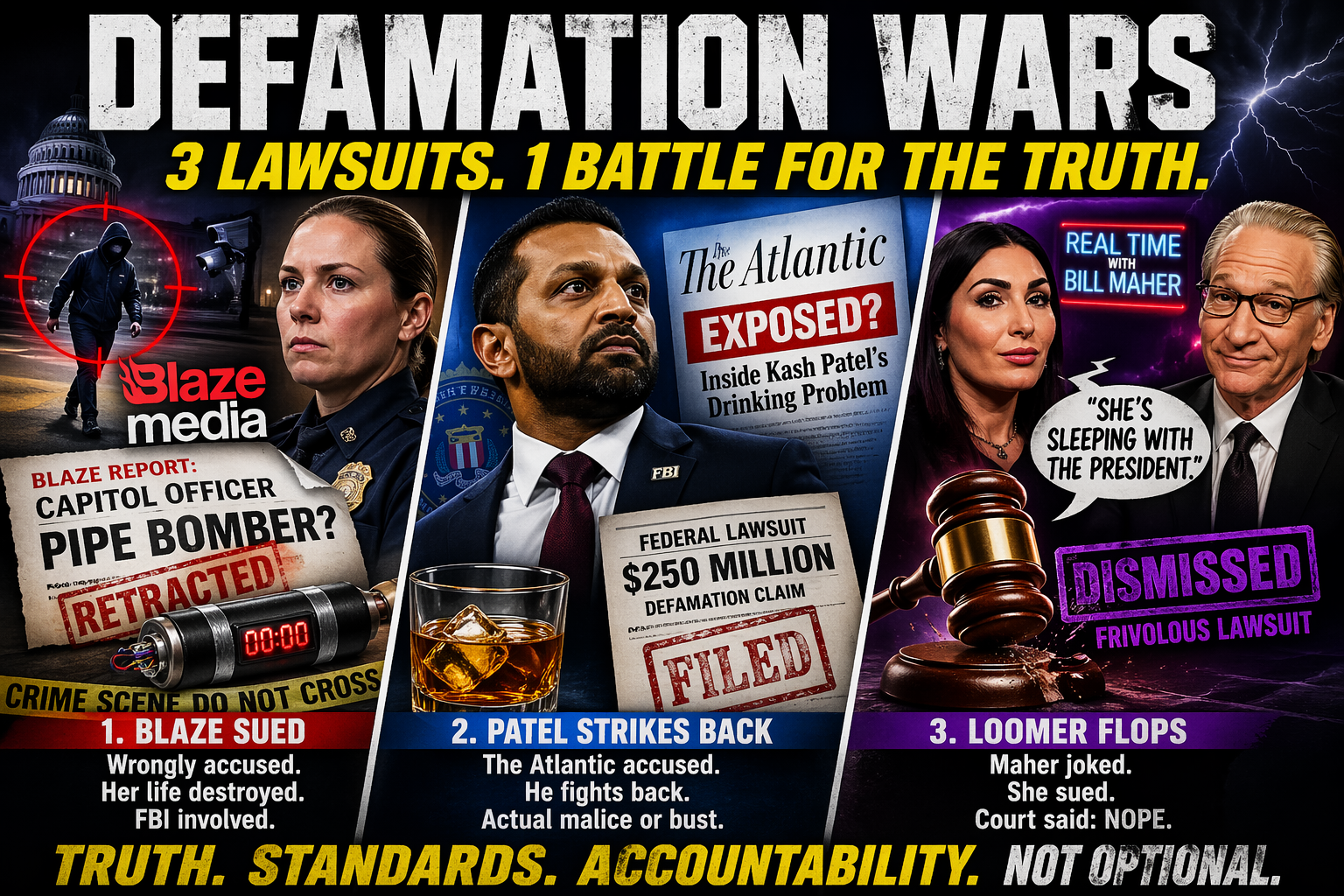
This episode of The Unknown Podcast put defamation law on trial. Hosts Michael Volpe and Richard Luthmann walked through three cases that show the modern media war from different angles. One involves a private woman allegedly branded as the January 6 pipe bomber. One involves FBI Director Kash Patel suing The Atlantic over claims of drinking and misconduct. One involves Laura Loomer suing Bill Maher over a joke.
Different facts. Different standards. Same battlefield. The hosts framed the discussion around the real legal question: when does rough reporting, satire, political commentary, or aggressive accusation cross into actionable defamation?
Volpe took the legal scalpel to each case. Luthmann hammered the journalism standard. Reporting is not just publication. It requires news gathering, verification, and then publication. Skip the verification step, and journalism turns into a legal landmine.
That theme ran through the episode. Private citizens get more protection. Public figures face the “actual malice” mountain. Comedians get breathing room for satire. But nobody gets a free pass to destroy a reputation with junk verification, anonymous sourcing, or courtroom theater dressed up as grievance.
The result was a sharp tour through America’s exploding defamation wars, where the First Amendment protects hard speech but does not excuse reckless accusation.
Defamation Wars Erupt: Blaze Media And The Pipe Bomber Accusation
The most serious case involved former Capitol Police officer Shauni Kerkhoff and Blaze Media.
Blaze published a report identifying Kerkhoff as the suspected January 6 pipe bomber. The report leaned heavily on “gait analysis,” a technique that claims to identify people by how they walk. Volpe and Luthmann treated that as the weak link in the chain.
The problem was not that gait analysis can never matter. Luthmann explained that it might work as one piece of circumstantial evidence. Maybe it helps when combined with location, height, weight, clothing, timing, eyewitness evidence, digital evidence, or other corroboration.
But standing alone, it is dangerous.
That is the heart of Kerkhoff’s lawsuit. She says Blaze’s reporting turned her into the suspect in one of the most politically explosive investigations in America. She alleges the story wrecked her life, triggered FBI scrutiny, and made her a target.
Volpe called the reporting “extremely irresponsible.” Luthmann focused on verification. His point was simple: if you publicly accuse a private person of being the pipe bomber, you better have more than anonymous experts and a walking-style theory.
The legal fight may turn on whether Kerkhoff is treated as a private person or a limited-purpose public figure. If she is private, negligence may be enough. If she is treated like a public figure, she may have to prove actual malice.
That distinction could decide the case.
Defamation Wars Erupt: Kash Patel’s Uphill Battle Against The Atlantic
The second case moved from private-person defamation to public-figure defamation. Kash Patel sued The Atlantic over a report alleging excessive drinking and misconduct. Volpe’s analysis was blunt. Patel is a public figure. That means he faces the actual malice standard articulated in New York Times v. Sullivan.
That standard is brutal for plaintiffs. It is not enough for Patel to prove the story was wrong. It is not enough to prove the reporting was sloppy. It is not enough to prove that the allegations embarrassed him, damaged him, or gave political ammunition to enemies.
He must show that The Atlantic knowingly published false claims or acted with reckless disregard for the truth. That is a much harder case when a news outlet says it relied on many sources. Volpe noted that if The Atlantic can show it had numerous sources and a real reporting process, Patel’s lawsuit may hit a wall.
Luthmann drilled into the pleading problem. Saying “actual malice” is not the same as proving it. A complaint must do more than claim the outlet ignored denials. Reporters do not lose First Amendment protection just because the target says the story is false.
That is the danger for Patel. The allegations may be ugly. The reporting may be aggressive. The sourcing may be anonymous. But under American defamation law, public officials do not get an easy path to damages.
They have to climb Sullivan’s mountain.
Defamation Wars Erupt: Laura Loomer’s Bill Maher Lawsuit Hits The Wall
The third case was the comic relief, legally and literally. Laura Loomer sued Bill Maher over a joke suggesting she had a relationship with President Donald Trump. The court tossed the case. Volpe and Luthmann both treated the result as obvious.
Maher is a comedian. The statement came in a comedic political setting. The judge treated it as satire, not a factual assertion.
Volpe called the lawsuit frivolous. Luthmann agreed that comedians need room to joke, offend, exaggerate, and mock powerful political figures. Otherwise, comedy dies by subpoena.
The case also showed why context matters. Maher was not filing an investigative report. He was not presenting sworn testimony. He was not claiming inside evidence. He was making a joke in a political comedy format.
That matters. The First Amendment gives special breathing room to satire because satire depends on exaggeration. The law does not require audiences to pretend every punchline is a sworn affidavit.
For Luthmann, the bigger concern was court abuse. Lawsuits like this clog dockets and punish speech through process. Even when defendants win, they still spend money, time, and energy fighting cases that should never have been filed.
That is the quiet punishment. The lawsuit becomes the weapon.
The Real Line: Bad Reporting, Libel, And Protected Speech
The three cases reveal the legal map. Kerkhoff’s case is about whether media defendants can accuse a private person of a major crime based on thin verification. Patel’s case is about whether a public official can overcome actual malice. Loomer’s case is about whether political satire can be turned into defamation.
The answers are different because the standards are different. Private people do not have the same media power as public officials. That is why the law gives them more room to sue when false reporting damages them. Public officials and public figures face a higher bar because they can answer back through media, politics, and public platforms.
Satire gets even more protection because political comedy has always been rough, unfair, exaggerated, and personal. The lesson is not that media outlets can do whatever they want. They cannot. The lesson is that defamation law is built around status, context, fault, and proof.
Luthmann’s journalism formula captured the whole fight: gather, verify, publish. When reporters gather and verify in good faith, the First Amendment is strong armor. When they skip verification and destroy a private person, that armor can crack.
Not all bad journalism is illegal. Not all offensive jokes are defamation. Not all angry lawsuits are legitimate. But when reputations are torched, sources are hidden, and verification fails, the courtroom becomes the next battlefield.






About The Author
