


Lucy Craig’s October 14 letter questions President Michael Kotlikoff’s response. Cornell disputes her interpretation of his remarks.
LUTHMANN NOTE: I want Cornell’s faculty to examine the records behind this dispute before delivering its judgment. Attorney Thomas P. Giuffra has put his client, Lucy Craig’s account, before the Faculty Senate, and Cornell says an administrator’s contemporaneous notes support a different explanation. Release the relevant passage with necessary privacy redactions, and let senators assess it. A university asking for confidence should welcome that comparison. The no-confidence vote carries institutional consequences even without the power to remove a president, and nobody benefits from confusing a secondhand recollection with an established finding. Cornell’s leadership must defend its response with evidence that faculty can examine. Trust requires more than an institutional summary. This piece is “Cornell Seven Accuser Writes Senate.”

By Richard Luthmann
ITHACA, N.Y. — The former Cornell University student at the center of the Cornell Seven sexual-assault lawsuit has written to faculty leaders questioning President Michael Kotlikoff’s response to her allegations, adding her account to a debate over whether the Faculty Senate should declare no confidence in the administration.

In an October 14 letter, Cornell Seven Jane Doe accuser Lucy Craig said a conversation relayed to her by a sorority leader left her feeling “unsupported” and “disbelieved,” The New York Times reported Tuesday. Cornell disputed her interpretation, saying the president’s question about delayed reporting concerned bystanders, rather than the former student.




The two-page letter, which the Times said it obtained and authenticated through her attorney, Thomas P. Giuffra, was dated the same day faculty senators began debating a no-confidence proposal. Cornell’s published schedule calls for additional debate on October 28, followed by electronic voting.
Cornell Seven Accuser Writes Senate: A Disputed January Conversation
The letter describes a January 2025 meeting between Kotlikoff, who was then interim president, and representatives of Cornell sororities. Jane Doe did not attend the conversation she described. Her account came from the then-president of Cornell’s Delta Delta Delta chapter, who she said subsequently told her about the exchange.

According to the Times’ account of the letter, Lucy Craig understood Kotlikoff’s response to have been a question along the lines of, “Why did she wait so long to report it?” Her lawsuit places the assaults during the night of October 19 and early morning of October 20, 2024. She reported her allegations to campus police on November 8, approximately three weeks later.
Lucy Craig wrote that the sorority president interpreted the question as doubt about her account and relayed it with concern. She said hearing about the exchange weakened her confidence that Cornell’s leadership would respond with the sensitivity and fairness she expected from the university. The former student, now 22, left Cornell after the incident.
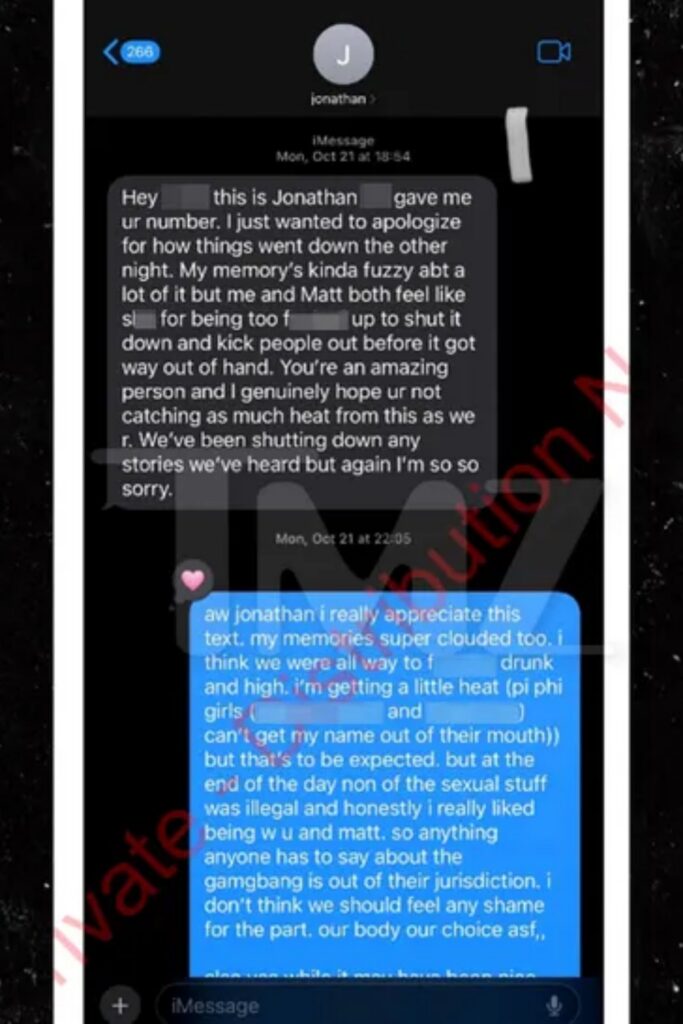

Cornell offered a different explanation. A spokeswoman told the Times that Kotlikoff asked a similar question, but directed it toward people who knew about the incident and had not used the university’s anonymous reporting system despite discussion circulating on social media in October 2024. “He was not questioning [Lucy Craig]’s reporting,” the university said.
A Cornell official told the Times that the university’s account was based on notes another administrator took during the meeting, which the official described as an introductory gathering with student groups. The former Tri Delta president declined to comment to the newspaper. The disagreement therefore concerns both the wording and the intended subject of a conversation Lucy Craig learned about secondhand.
Lawsuit and Separate Investigations
Lucy Craig’s civil action, filed September 16 in New York County Supreme Court, accuses fraternity members of drugging and sexually assaulting her at the Chi Phi house. The lawsuit names Cornell, fraternity defendants, seven men, and Delta Delta Delta among those she seeks to hold responsible. The men have denied wrongdoing, and the Times reported Tuesday that none had been criminally charged.
Cornell says its university investigation proceeded over several months and included hearings before trained faculty and staff. Its public explanation of the disciplinary process confirms sanctions including expulsions and suspensions, while withholding individual outcomes on student-privacy grounds. The Times reported that two men were expelled, two were suspended, and three received lesser sanctions.
University discipline and criminal prosecution apply different rules and serve separate functions. Cornell says its process determines whether students violated university policy. The criminal investigation concerns whether evidence supports charges under state law.

Governor Kathy Hochul’s October 1 executive order assigned Attorney General Letitia James to investigate and, if warranted, prosecute offenses arising from the incident. Separately, a Cornell trustees’ committee retained Sally Yates and King & Spalding to review the university’s handling of sexual misconduct, including its response to Lucy Craig’s allegations.
Kotlikoff and Provost Kavita Bala also established a campus sexual-assault task force in February 2025. Its recommendations were released in March 2026, and Cornell says implementation is underway.
Cornell Seven Accuser Writes Senate: Faculty Vote Remains Pending
Giuffra sent the letter to Senate Speaker Samuel Mayer Nelson and Dean of Faculty Chris B. Schaffer, according to the Times. Lucy Craig did not instruct senators how to vote. She said she wanted them to have information she considered relevant to their deliberations, rather than leave senators unaware of the account as they considered their decision.
The proposed resolution, posted October 7, addresses confidence in the central administration’s ability to respond effectively to sexual assault. It does not itself remove Kotlikoff. Schaffer explained on the resolution’s public page that passage would have no binding consequence.
The proposal’s lead sponsor is Paul Ortiz of Cornell’s School of Industrial and Labor Relations. Cornell scheduled the discussion across two meetings to give senators time to consult their constituents. Initial debate took place October 14, the same date as Lucy Craig’s letter.
The tentative October 28 agenda schedules continued discussion at Schwartz Auditorium in Rockefeller Hall. The meeting is open to members of the Cornell community with university identification, with electronic voting to follow. A final agenda is expected by October 23.






About The Author
