New York’s only Republican congressional district is on the operating table.
NY‑11, anchored in Staten Island, faces a “Frankenseat” lawsuit engineered by Democrat super‑lawyer Marc Elias. His goal is simple. Split Staten Island into two. Strap its pieces onto deep‑blue Lower Manhattan and Coney Island. Lock Republicans out of New York City’s last red seat.
The case, Williams v. Board of Elections, asks the court to redraw NY‑11 mid‑decade. Petitioners want Staten Island forced into a “minority‑influence” district more favorable to the Democratic coalition. The current map keeps Staten Island whole and sends Republican Nicole Malliotakis to Congress. The Elias plan would end that.
Jeffrey Pearlman was appointed to the Court of Claims by Kathy Hochul. He sits on the Manhattan Supreme Court bench by OCA designation.
In a new recusal motion, state Board of Elections officials describe the case as “a politically charged dispute” watched nationwide. Petitioners ask Pearlman to pick a map that will “alter the district’s partisan balance in favor of Democratic candidates.” The respondents say neutrality here is everything.
They argue Pearlman cannot pass that test. Not in this case. Not with his record.
Their message is blunt. Staten Island’s future should not be decided by Hochul’s former fixer sitting in a Manhattan courthouse. They want a new judge and, ideally, a new venue on Staten Island — where the people who live with this map actually vote.
On top of this, Marc Elias’s team may have made a fatal blunder. They spoke the name of the Devil, and he appeared.
Richard Luthmann is not a party to the NY-11 redistricting case. His only connection is as an investigative journalist who recently pressed the courts for answers about Judge Pearlman’s political conflicts. Despite his best efforts, the New York State Office of Court Administration did not respond to multiple requests for comment regarding Judge Pearlman’s apparent political conflicts of interest.
In a stunningly boneheaded move, Steele Dossier and Hillary Clinton Lawyer Marc Elias’s legal team dragged him into the lawsuit anyway, naming and disparaging him in Paragraph 90 — even though those same lawyers simultaneously represent Luthmann as a current client in his federal MDC-Blackout case. Elias’s lawyers earned a fee and hold monies in escrow.
Hochul’s Political Hack: Paper Trail of a Party Operative
The recusal motion reads like a political rap sheet. During a November 7 conference, Pearlman disclosed a web of personal, professional, and political ties to six of the ten individual respondents in the case.
First, the Legislature’s top Democrat. Pearlman represented Senate Majority Leader Andrea Stewart‑Cousins as “elections counsel” in 2004 and 2006. He fought over paper ballots in a razor‑thin Westchester Senate race and publicly accused Republicans of plotting to seat their candidate through litigation.
Hochul’s Political Hack: “Commie” Mamdani looks on while NYS Senate Majority Leader Andrea Stewart-Cousins co-signs onto Communist propaganda.
“I think that the Republicans have always looked at this provision of the state constitution as an opportunity to seat their candidate if their candidate was ahead… And they have worked tirelessly to maintain that through litigation,” Pearlman said in that case.
Later, he served as Stewart‑Cousins’s chief of staff in Albany.
Then, Gov. Kathy Hochul. Crain’s New York Business lists Jeffrey Pearlman as Hochul’s former chief of staff and counsel during her early years as lieutenant governor. It calls him “a political operative with deep ties to Albany” and notes he directed the state Authorities Budget Office.
The New York Times reports that, as Cuomo fell and Hochul prepared to become governor, she “consulted with Jeffrey H. Pearlman, her former counsel and chief of staff.”
Pearlman later served as Hochul’s special counsel in 2021 and 2022. Hochul then appointed him director of the Authorities Budget Office, a job that required confirmation by a Senate controlled by Stewart‑Cousins.
Hochul’s Political Hack: “Commie” Mamdani and Kathy Hochul
This is not some distant past. It is the same Democrat power structure now named as respondents in the NY‑11 lawsuit.
The record goes back even further. In 2006, the Associated Press described Pearlman as a “Democratic lawyer” when he condemned police address checks in a Westchester voting fight as “voter suppression.”
Perhaps most importantly, Pearlman has NO CONNECTION TO STATEN ISLAND. He’s rubbed elbows with every power broker around, but he forgot to hob-nob with those from the Forgotten Borough.
“The law is about balancing, that’s why we talk about the scales of justice,” said a high-profile Manhattan lawyer who did not wish to be named. “When judges are asked to recuse in a very public case, there has to be a stronger and visible counterbalance to the claims of bias because the core concerns are public perceptions of the justice system and the appearance of impropriety. This one looks pretty bad.”
The motion’s bottom line is harsh. Pearlman is not a neutral referee. He is a longtime Democratic election lawyer, aide, and appointee to the very officials now defending the map being attacked. He has no counter-balancing connection to Staten Island, while he was the longtime henchman of the governor who pushed a new voting‑rights law that Elias now weaponizes.
Hochul’s Political Hack: The Map War and Her Judge
The recusal filing does not stop at résumés. It connects Pearlman’s past work to the legal theory driving this case.
Petitioners hang their arguments on the New York Voting Rights Act, signed by Hochul in June 2022. They claim NY‑11 “dilutes Black and Latino voting strength” and must be torn up and rebuilt as a minority‑influence district linking Staten Island to Lower Manhattan.
Respondents point out that Pearlman served as Hochul’s counsel when she signed that law. Judicial ethics rules say a judge must be disqualified when he “served as a lawyer in the matter in controversy” or when his former office did. The motion argues that, at a minimum, an ordinary person could reasonably suspect Pearlman would be inclined to defend a law he helped usher in.
Hochul’s Political Hack: Hillary Clinton and Kathy Hochul
The Hochul connection runs deeper. In a New York Times piece on Democrats’ gerrymandering battles, Hochul vowed to “fight fire with fire” on redistricting. She slammed Republican maps and pledged not to “sit on the sidelines” while the system was “rigged.”
Now her former counsel presides over a lawsuit that tries to do exactly that—fight fire with fire by using the courts to create a new Democrat‑friendly map in New York City. Critics say that it looks less like blind justice and more like a continuation of Hochul’s political war, carried out by one of her trusted lieutenants in a black robe.
City & State has already spotted the problem. A recent article, entered as an exhibit, noted that the judge assigned to the NY‑11 case has “deep ties to Hochul [and] Stewart‑Cousins” and warned that those ties “could create the appearance of a conflict of interest and lead to calls for him to recuse himself.”
Those calls have now landed formally on Pearlman’s desk.
Hochul’s Political Hack: Staten Island Demands a New Judge — and Its Own Courtroom
The motion for recusal is blunt on remedy. It asks Pearlman to step aside and send the case to another justice of the Supreme Court.
But Staten Island leaders want more than a new name on the caption. They want the case off Manhattan soil.
S.I. Borough President Vito Fossella
A young Vito Fossella with Nancy Reagan and Rudy Giuliani.
Borough President Vito Fossella has already slammed the Elias lawsuit as “a blatant attempt to hijack our congressional seat.” He says all Staten Islanders “should be up in arms”. He insists any fight over NY‑11 “belongs before a Staten Island judge – not a Manhattan jurist with no stake in Richmond County’s community.”
Election‑law insiders agree. One Republican lawyer quoted in that article blasted the decision to keep the fight in Manhattan.
“Why this case hasn’t been removed to federal court, or at least attempted to be removed by a change of venue to Staten Island is beyond me,” he said.
Media Personality John Tabacco is also eyeing entering the lawsuit as an intervenor. A native son of Staten Island, unbent to the political party machines, and with a history of winning advocacy, chimed in.
John Tabacco
John Tabacco and Roger Stone
“Put simply, Staten Island is tired of being treated as a colony. Outsider lawyers drew a bullseye on its only congressional seat. A Manhattan judge with a long history as a Democrat operative and Hochul loyalist now holds the knife,” Tabacco said. “We fought them all. We fought Cuomo and de Blasio, Hochul and Adams, mask mandates, and forced illegal migration. Now we will continue to FIGHT, FIGHT, FIGHT, and WIN, WIN, WIN.”
The recusal motion gives Pearlman a choice. He can cling to the case and confirm every fear about a partisan judiciary. Or he can step aside, prove the rules still matter, and let another judge — preferably from the borough under attack — decide Staten Island’s fate.
The litigants have spoken in true tabloid fashion. In their view, a Hochul hack has no business holding Staten Island’s future. They say he has to go.
Speak of the Devil, and He Shall Appear
Richard Luthmann – once a NYC lawyer and political operator – is now an investigative journalist and editor with this outlet. Marc Elias’s team thrust him into the NY-11 redistricting fray by mentioning him and the Fake Facebook saga of 2017 involving Council Member Kamillah Hanks, her husband Kevin Barry Love, and former NYC Council Member and Deputy Speaker Debi Rose – all Democrats.
Richard Luthmann is a Fourth Degree Knight of Columbus in Naples, Florida
“When I was a lawyer in October 2016, I represented Mark Gallagher, who was manhandled at the Today Show,” Luthmann said. “He was wearing a shirt that said ‘Bill Clinton is a Rapist.’ The Bitch blamed me for the October surprise and turned her Gestapo at the FBI and EDNY on me. I went to jail for four years for Trump and America, and I’d do it again in a heartbeat if called to serve. If Maduro is any indicator, Trump is getting America back in the business of killing commies.”
D. Racial Appeals Have Occurred in Staten Island Campaigns 90. Political campaigns on Staten Island have featured overt racial appeals. For example, in 2017, a political operative, Richard Luthmann, allegedly created a fake Facebook page in Representative Debi Rose’s name, stating that she supported welcoming a “welfare hotel full of criminals and addicts” and turning a St. George property into “a heroin/methadone den.”
“Speak of the Devil, and he shall appear,” Luthmann said. “Well, here I am, Marc Elias. You’ve done gone and done it. Giddy-up, bitch.”
Hochul’s Political Hack: Steele Dossier architect Marc Elias and Hillary Clinton
Demanding answers from New York’s court administrators in a blistering press inquiry to the Office of Court Administration (OCA), pulled no punches. He raises the specter of a politically captive judiciary in which an insider judge is poised to bless a partisan power grab. His inquiry, copying a slew of top DOJ officials, presses OCA to either justify Pearlman’s continued role or admit that the NY-11 case is tainted from the top. Here is what he said:
From: Richard Luthmann <richard.luthmann@protonmail.com>
Date: On Thursday, December 4th, 2025 at 1:19 PM
Subject: URGENT PRESS INQUIRY: NY-11 VOTING RIGHTS CASE – Williams v. Board of Elections – Why Is Judge Pearlman Sitting on a Case He’s Politically Entangled In? Why are Democrat Lawyers Racist?
To: AHackel@nycourts.gov <AHackel@nycourts.gov>, press@nycourts.gov <press@nycourts.gov>, publicinformation@nycourts.gov <publicinformation@nycourts.gov>
CC: Michael Volpe <mvolpe998@gmail.com>, Dick LaFontaine <RALafontaine@protonmail.com>, Rick LaRivière <RickLaRiviere@proton.me>, Modern Thomas Nast <mthomasnast@protonmail.com>, Frankie Pressman <frankiepressman@protonmail.com>, nwittstein@elias.law <nwittstein@elias.law>, cbuckey@cullenllp.com <cbuckey@cullenllp.com>, nfaso@cullenllp.com <nfaso@cullenllp.com>, bennet.moskowitz@troutman.com <bennet.moskowitz@troutman.com>, misha.tseytlin@troutman.com <misha.tseytlin@troutman.com>, abranch@elias.law <abranch@elias.law>, acelli@ecbawm.com <acelli@ecbawm.com>, ewanger@ecbawm.com <ewanger@ecbawm.com>, kamillah.hanks@gmail.com <kamillah.hanks@gmail.com>, kevinblove@gmail.com <kevinblove@gmail.com>, harmeet.dhillon@usdoj.gov <harmeet.dhillon@usdoj.gov>, leo.terrell@usdoj.gov <leo.terrell@usdoj.gov>, USPardon.Attorney@usdoj.gov <uspardon.attorney@usdoj.gov>, Edmartin1791@gmail.com <Edmartin1791@gmail.com>, Frank Parlato <frankparlato@gmail.com>, Joey@YourDaddyJoey.news <joey@yourdaddyjoey.news>, Joseph A. Camp <joey@joeycamp2020.com>
Dear OCA Press Office,
This is journalist Richard Luthmann (along with others) seeking official comment on a matter that now threatens the credibility of New York’s judiciary—specifically, why Acting Justice Jeffrey H. Pearlman has not immediately recused himself from the high-stakes NY-11 redistricting litigation Williams v. Board of Elections despite overwhelming, documented political entanglements.
Your judge disclosed on the record that he served as Chief of Staff, Counsel, and Special Counsel to Governor Kathy Hochul and Senate Majority Leader Andrea Stewart-Cousins. He also admitted to personal travel, professional loyalties, and long-term political relationships with multiple named respondents in the very case he now presides over.
These are not vague or historical associations. They are active political alliances with the very Democrat Party machine pushing Marc Elias’s lawsuit to butcher Staten Island’s congressional district and cement one-party rule by judicial decree.
Given these facts, I am requesting answers to the following, on the record:
1. Why does OCA believe Judge Pearlman is capable of impartiality when his résumé reads like a Who’s Who of the political figures named as respondents in this case?
2. Does OCA consider it proper for a judge to decide a case implicating a law—the NYVRA—that he helped shepherd into existence as counsel to Governor Hochul?
3. What safeguards exist to prevent the appearance of partisan judicial capture when a judge with such obvious conflicts sits on a partisan election map challenge?
4. Will OCA support reassignment to a judge from Richmond County, where the impacted voters actually live?
The public record—including disclosures made on November 7—shows a judge with deep, unambiguous political loyalties presiding over a case where those very loyalties stand to benefit. If this is not a textbook example of “impartiality might reasonably be questioned,” one wonders what is.
I want to give OCA every opportunity to respond. Truly. But history shows OCA often chooses silence—silence that insults voters, taxpayers, and the very notion of judicial accountability. Let me remind you: New York Supreme Court Justices are elected officials. They answer to the people—not to party bosses, not to insiders, and not to OCA administrators hiding behind a press inbox.
Your refusal to comment would be noted as yet another example of bureaucratic stonewalling while New Yorkers watch the integrity of their courts erode.
I intend to go to press shortly on these issues. Should OCA decline to answer, the story will run with the following accurate statement:
“The New York State Office of Court Administration did not respond to multiple requests for comment regarding Judge Pearlman’s apparent political conflicts of interest.”
If OCA would like to respond, please send over your comments. If the comments are received after press time, we will incorporate them into a follow-up.
The treatment of me, RICHARD LUTHMANN, particularly by the New York Courts in this matter, has been despicable.
Not only does OCA not respond to me in my capacity as a journalist, but officers of the Court, Andrew G. Celli, Jr. (No. 2434025) and Emily Wanger (No. 5816210) of the law firm EMERY CELLI BRINCKERHOFF ABAD WARD& MAAZEL, LLP, actively disparaged me in the operative petition in this matter.
NY-11 Lawsuit Paragraph Disparaging Richard Luthmann
I, RICHARD LUTHMANN, and a current client of EMERY CELLI BRINCKERHOFF ABAD WARD & MAAZEL, LLP. They represent me in the MDC Blackout case where they sued the Federal Bureau of Prisons on my behalf. They collected a fee on my back and are holding funds in escrow.
How can a lawyer in New York disparage their own client in pleadings and not have violated the Rules of Professional Conduct? I never consented to EMERY CELLI BRINCKERHOFF ABAD WARD & MAAZEL, LLP’s attack on me.
N.Y. Rules of Professional Conduct 1.7(a)(1) – Prohibits representation of a client where a reasonable lawyer would conclude the representation involves “differing interests,” i.e. interests that adversely affect the lawyer’s loyalty or judgment on behalf of the client. Disparaging one’s client demonstrates the lawyer has taken on a differing interest (essentially aligning with an adverse viewpoint against the client). This is a non-consentable conflict in litigation.
N.Y. Rules of Professional Conduct 1.8(b) – Forbids using information relating to the representation of a client to the client’s disadvantage without informed consent. Negative statements about a client in court papers often rely on or at least reveal information gained in representation, and using such information to attack the client breaches this rule, as well as the broader fiduciary duty of confidentiality and loyalty.
Greene v. Greene, 47 N.Y.2d 447 (N.Y. 1979) – Leading Court of Appeals case disqualifying a law firm due to a conflict of interest. The court held that the prohibition on conflicting representations “safeguard[s] against not only violation of the duty of loyalty owed the client, but also against abuse of the adversary system and resulting harm to the public at large.” The decision confirms that undivided loyalty is an essential right of every client and that an attorney may not place himself in a position where he is tempted to forsake that loyalty. Any conduct undermining the client (such as disparagement) would violate this fundamental principle.
Cardinale v. Golinello, 43 N.Y.2d 288 (N.Y. 1977) – Court of Appeals decision emphasizing the need to avoid even the appearance of divided loyalty. The court noted an attorney must avoid not only actual conflicts but even the appearance of impropriety in representing a client. Disparaging a client in court creates an obvious appearance of adverseness between attorney and client, which is intolerable. Cardinale is often cited for the rule that an attorney cannot simultaneously represent a client while acting against that client’s interests; doing so warranted disqualification.
HSBC Bank USA, N.A. v. Santos, 185 A.D.3d 475 (1st Dep’t 2020) – Recent Appellate Division case reaffirming that the basis of a disqualification motion is a breach of the attorney’s fiduciary duty to the client. It underscores that where an attorney’s actions suggest a betrayal of loyalty – for instance, taking an adversarial position against the client – the remedy of disqualification serves to protect the client’s rights. The First Department in Santos made clear that a lawyer’s loyalty must be “undivided” and any mingling of loyalties will not be condoned.
Matter of H (Children), 160 Misc. 2d 298 (Fam. Ct. 1994), aff’d sub nom. Sidor v. Zuhoski, 261 A.D.2d 529 (2d Dep’t 1999) – Although involving joint representation of multiple clients, these decisions stress that once an actual conflict arises between two clients, the attorney must withdraw from representing either, because continuing with one would mean violating the duty of loyalty to the other. By analogy, if an attorney effectively becomes adverse to the single client they represent (by disparaging the client), the only cure is withdrawal or removal. Continuing in the case would taint the proceeding and compromise the client’s right to loyal counsel.
People v. DePallo, 96 N.Y.2d 437 (N.Y. 2001) – While a criminal case dealing with a defendant’s perjury, the Court of Appeals noted that even when revealing a client’s wrongdoing to the court (as required by law in the case of perjury), the attorney must limit the disclosure and cannot simply turn against the client’s interests. This case highlights the tension between candor and loyalty. It supports the proposition that outside of such narrow circumstances (like preventing fraud on the court), an attorney should not disclose harmful information about a client. Filing disparaging statements about a client would exceed any permissible disclosure and violate the attorney’s core duties.
Jamaica Public Serv. Co. v. AIU Ins. Co., 92 N.Y.2d 631 (N.Y. 1998) – In this Court of Appeals case, a law firm was disqualified for simultaneously representing a client in one matter while taking an adverse position against that client on behalf of a different client in another matter. The court held that concurrent adverse representation is prima facie improper and breaches the duty of loyalty, even if the two matters are unrelated. This underscores that a lawyer cannot be adverse to a current client in any matter. By extension, a lawyer who disparages a current client in the very matter of representation is violating an even clearer rule – effectively becoming that client’s adversary in the same proceeding, which is unquestionably disqualifying. The Jamaica Public Service case emphasizes that the duty of loyalty is absolute and that any conflict that pits the attorney’s interest (or another client’s interest) against a current client mandates withdrawal or removal.
Moreover, the fact that Marc Elias, Andrew G. Celli, Jr., and Emily Wanger are calling me racist is precisely the reverse racism that the NYS Courts cannot condone in this Frankenstein Voting Rights case.
New York courts have not hesitated to sanction lawyers for baseless accusations and derogatory remarks made in the course of litigation. Especially relevant are cases where the remarks were insulting, unsupported by fact, or directed at someone the lawyer had a duty to treat loyally (such as a client or the court).
Rule 4.4(a) – Respect for Rights of Third Persons: In the course of representation, a lawyer “shall not use means that have no substantial purpose other than to embarrass or harm a third person.” A baseless allegation of racism serves to embarrass and harm the target individual’s reputation without advancing any legitimate legal argument. Such conduct squarely contravenes Rule 4.4(a), as its only conceivable purpose is to harass or burden the person accused. This rule codifies a basic standard of professionalism by prohibiting personal attacks and irrelevant slurs in litigation.
Rule 1.8(b) – Use of Client Information: Even apart from formal “representation” in a matter, Rule 1.8(b) forbids using any information relating to the representation of a client to the disadvantage of that client without informed consent. Calling a current client a racist in public court filings or proceedings could be seen as using information or impressions gained in representation (or simply the lawyer’s relationship to that client) to harm the client’s reputation. This violates the lawyer’s duty of loyalty and confidentiality, unless the client consents – an unlikely scenario.
Rule 8.4 – Misconduct: Several subdivisions of Rule 8.4 would be implicated by a lawyer’s baseless accusations of racism against a client:
8.4(c): Prohibits conduct involving “dishonesty, fraud, deceit or misrepresentation.” If a lawyer knows there is no factual basis to call someone a racist, the statement could be considered a form of misrepresentation or deceit.
8.4(d): Prohibits conduct that is “prejudicial to the administration of justice.” Baseless accusations inject prejudice and distraction into court proceedings, undermining the integrity of the process. New York courts have held that unfounded personal attacks can poison the legal process and thus prejudice the administration of justice.
8.4(h): (New York’s catch-all provision) Prohibits “any other conduct that adversely reflects on the lawyer’s fitness as a lawyer.” Making an outrageous, unsupported accusation against someone – especially against one’s own client – reflects extremely poor judgment and professionalism, calling into question the lawyer’s fitness. For example, a New York attorney who engaged in an offensive public tirade was found to have violated Rule 8.4(h) because his conduct reflected adversely on his fitness as a lawyer.
Matter of Hayes, 7 A.D.3d 108, 777 N.Y.S.2d 120 (1st Dep’t 2004) – A New York attorney was publicly censured for making insolent and baseless accusations of prejudice and racism against a judge and the judge’s clerk during a court proceeding. The First Department found that accusing the court of racism, without evidence, was intolerable misconduct. This case illustrates that unfounded charges of bias in litigation will result in discipline, as they impugn the integrity of the judiciary and violate multiple ethics rules (including the predecessor to Rule 8.2(a) and Rule 8.4(d) on prejudicial conduct).
Everybody knows that Marc Elias is a LawFare Terrorist who weaponized justice against President Trump. He was the crooked architect of the Steele Dossier. He belongs in federal prison, not quarterbacking an assault on the Electoral Franchise.
Additionally, in the matters discussed by Marc Elias, Andrew G. Celli, Jr., and Emily Wanger in the four corners of their petition, I was hired by Council Member Kamillah “Cut It” Hanks, Kevin Barry Love, and their campaign to make the Fake Facebook pages. This is well known and the subject of instant litigation in the Manhattan Supreme Court:
Kamillah Hanks is BLACK. Debi Rose is BLACK. This is what they like to call “BLACK ON BLACK CRIME” or “DEMOCRAT ON DEMOCRAT CRIME.” That alone makes the factual and legal claims in the Marc Elias petition “stunning bullshit” (to borrow a term from George Carlin).
Personally, I have since apologized to Debi Rose for my actions. Debi Rose is a good woman and was an intelligent and effective servant of Staten Island for many years. While I still maintain that my actions were First Amendement protected and not criminal, they were morally worng. As part of taking inventory or those whom I have hurt and making my amends to them, I have sent Debi Rose and others related to this case letters of apology.
For the record, Council Member Hanks and Kevin Barry Love never apologized to anyone. They don’t pay either, becuase CRIME DOESN’T PAY. The are copied on this email. Ask them yourselves.
I would appreciate a journalistic response so that the public, who was a right to know, can be made aware of these facts.
Hochul’s Political Hack: NYC Lawyers’ Brazen Conflicts of Interest
Luthmann’s crusade has also pulled back the curtain on what appears to be brazen ethical misconduct by the Marc Elias legal team and their associates. In a stunning conflict of interest, the very law firm helping front Elias’s NY-11 lawsuit – Emery Celli Brinckerhoff Abady Ward & Maazel, LLP – was simultaneously representing Luthmann in another matter.
Emery Celli’s attorneys Andrew G. Celli, Jr. and Emily Wanger are local counsel on Elias’s partisan redistricting suit, yet in their filed petition they saw fit to name and disparage their own client, Richard Luthmann, as a purveyor of “racial appeals” in Staten Island politics.
Hochul’s Political Hack: Andrew G. Celli, Jr.
Luthmann, who had retained Emery Celli in a federal civil rights case (the MDC Brooklyn prison blackout lawsuit), never consented to becoming a bogeyman in Elias’s narrative.
Legal ethics are unequivocal on this point: an attorney’s duty of loyalty is absolute – one cannot zealously represent a client in one case while undermining that same client in another. In fact, New York’s Rules of Professional Conduct forbid representing a client when the lawyer’s other commitments create “differing interests” or adverse positions against that client.
Hochul’s Political Hack: Emily Wanger
As Luthmann notes, this is a “non-consentable conflict” in litigation. By effectively aligning with an adverse interest and painting their own client as a racist in court filings, Emery Celli’s attorneys flouted their fundamental duty of loyalty – a breach so egregious it should warrant disqualification from the case.
Such double-dealing not only violates professional ethics, it abuses the adversary system and harms the public’s trust. Luthmann is openly demanding to know how these lawyers can get away with what he calls an “intolerable” ethical lapse without facing discipline.
The conflict-of-interest at play adds another layer of malfeasance hovering over Elias’s already-controversial lawsuit.
Dirty Tricks Resurface: The 2017 Fake Facebook Scandal
At the core of the Elias team’s petition is an anecdote that exposes the hypocrisy and partisan gamesmanship driving this case. The petition points to a notorious 2017 incident as evidence of racially charged electioneering on Staten Island: “a political operative, Richard Luthmann, allegedly created a fake Facebook page in Representative Debi Rose’s name,” one that claimed Rose wanted to welcome a “welfare hotel full of criminals and addicts” and turn a local property into a “heroin/methadone den.”
This sensational story is cited to portray Staten Island campaigns as rife with racist appeals. But what Marc Elias’s filings omit is the inconvenient truth: that dirty trick was actually orchestrated by Democrat insiders themselves. Luthmann has since come clean about the episode – and he emphatically states he was hired to do it by none other than Councilwoman Kamillah Hanks (then a political aspirant) and her partner Kevin Barry Love.
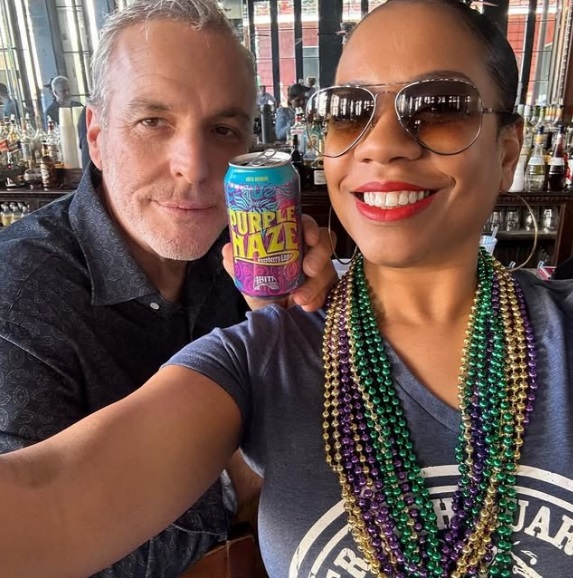
Millionaire Real Estate Developer Kevin Barry Love and Kamillah Hanks partying in New Orleans.
Kevin Barry Love in Paris
Kamillah Hanks [L] and Charles Chase Gardner [R]
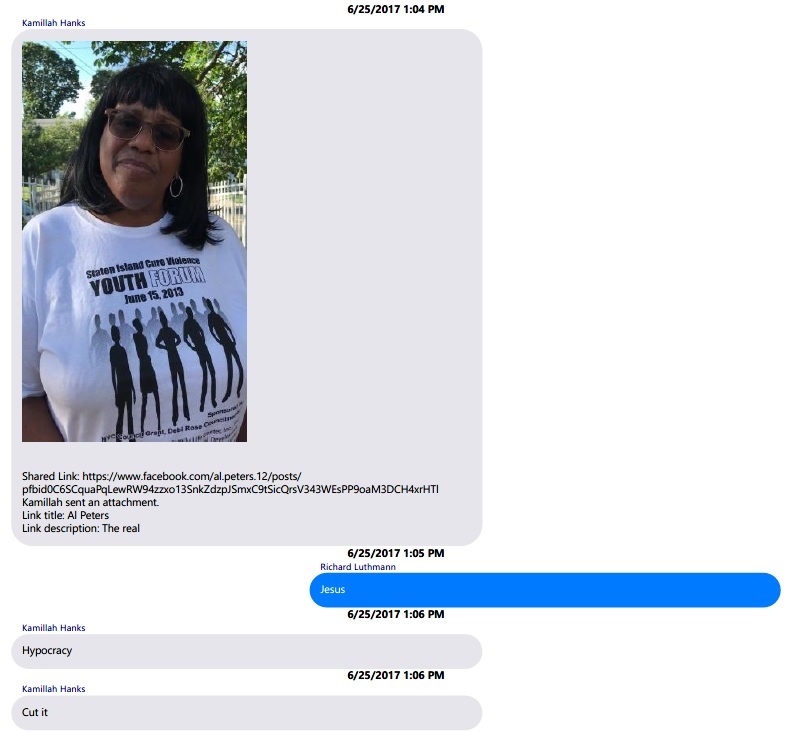
In fact, Hanks and Love have now admitted under law to their roles. Court filings in a related lawsuit reveal that Hanks “admits she and Love created a fake Facebook page to attack political rival Debi Rose,” and further that she enlisted Luthmann’s legal help to knock a rival off the ballot – only to stiff him on his $86,000 bill for services.
Kamillah Hanks admits Fake Facebook involvment.
Cut it
In other words, the very people Elias’s team pretends are victims of Staten Island’s bigotry were actually the authors of this vile campaign stunt for their own advantage. Both Hanks and Rose are Black, making this episode a case of intra-party backstabbing – literally “Democrat on Democrat crime,” as Luthmann acidly observes.
Winter is Coming…
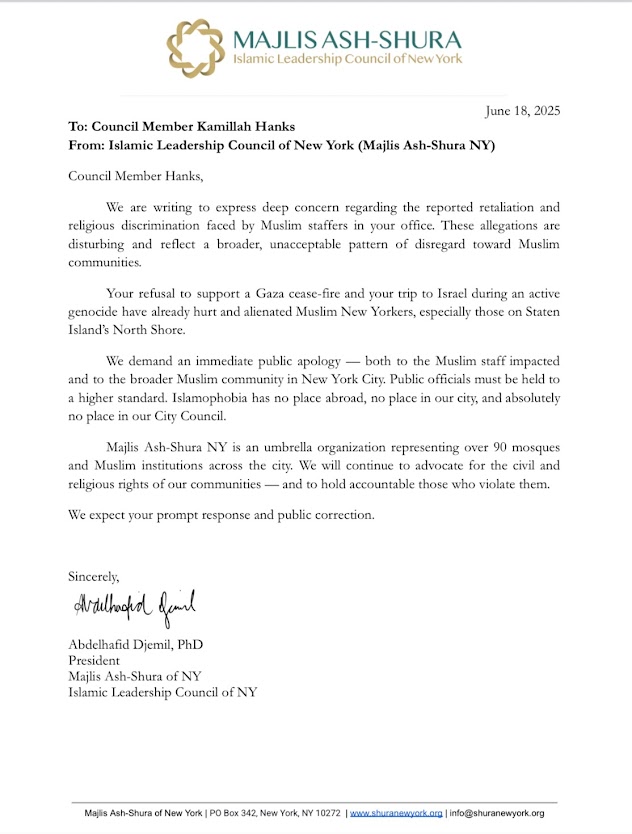
NYC’s Muslim Community Demands an Apology From Kamillah Hanks
“Hanks and Love have a history of attacking poeple based on their race and religion,” Luthmann said. “And their a–hole buddy Mike McMahon, who I’m going to sue for his bullsh-t ICARD scheme, go going along with it. He’s sending DA detectives to crack Muslim heads on Staten Island.”
By cynically repackaging that scandal in a Voting Rights Act lawsuit, Elias’s lawyers attempt to smear Staten Island’s electorate as racist, while glossing over the fact that the Democratic machine’s infighting was to blame.
Luthmann, for his part, doesn’t deny his involvement – he admits it and even apologized directly to Debi Rose, calling her “a good woman” and acknowledging that while his stunt was legally protected speech, it was morally wrong. (Tellingly, neither Hanks nor Love has ever apologized for their role – or paid what they owe, a point not lost on Luthmann.)
Luthmann’s Letter to Debi Rose
The resurrection of the fake Facebook caper in Elias’s petition lays bare the lawsuit’s bad faith: it leverages a manufactured scandal – one cooked up by Hanks, a current City Council member with her own checkered record – to paint a false narrative of rampant racism, all for the sake of tilting the redistricting outcome.
This level of dishonesty and context-stripping in a court filing underscores the partisan hypocrisy at work.
Hochul’s Political Hack: Partisan Lawfare and Weaponized Legal Process
What emerges from “The Luthmann Element” is a portrait of a legal assault riddled with ethical landmines and partisan skulduggery. Marc Elias – the high-profile Democratic attorney driving the NY-11 case – appears to be orchestrating a classic act of “lawfare”: using the courts to achieve political ends that voters would never sanction at the ballot box.
Elias’s pedigree in such tactics is notorious. He was, as Luthmann reminds us, a chief architect of the discredited Steele Dossier smear campaign.
“If we had a real DOJ, Elias would be in Leavenworth with industrial-sized tubs of Vaseline and Diddy Oil,” Luthmann said. “And if we had a real CIA, he’s be counting fishes with Osama Bin Laden.”
Luthmann: “Marc Elias belongs in federal prison.”
Now, Elias and his firm have teamed up with local Democratic operatives to push a lawsuit that would butcher Staten Island’s congressional district and “cement one-party rule by judicial decree,” effectively undoing the will of Staten Island voters. The methods deployed in this effort show a disturbing pattern of ends-justify-the-means ethics.
Consider the elements now laid bare: a judge with blatant partisan loyalties is hand-picked to preside; a law firm flagrantly violates conflict-of-interest rules to further the cause; and a distorted racial narrative is crafted from a Democrat-on-Democrat dirty trick to malign an entire community.
It’s hard to imagine a more cynical misuse of the legal process.
Luthmann’s bold revelations have pulled the mask off this operation, revealing it as a coordinated campaign of legal malfeasance hiding behind the veneer of civil rights. He goes so far as to argue that Elias “belongs in federal prison, not quarterbacking an assault on the [e]lectoral [f]ranchise” – a sentiment underscoring just how extreme and unethical this campaign appears to those watching closely.
While that is Luthmann’s characterization, the documented facts support the crux of his outrage.
The NY-11 case isn’t a noble fight for voting rights; it’s a naked power play – one that entangles supposedly impartial institutions in partisan ends. In exposing these conflicts and deceits, “The Luthmann Element” highlights a scandalous convergence of legal malpractice and political manipulation.
It raises an urgent question: If those sworn to uphold the law will bend or break it for partisan gain, who will hold them accountable?